
Inside a 20,000-Orders-a-Day Automated Packing Line for a Baby & Children’s Brand
Case Study · Maternity & Baby E-Commerce Fulfillment
Inside a 20,000-Orders-a-Day Automated Packing Line for a Baby & Children's Brand
Peak-season backlogs, overnight overtime, and platform penalties are a familiar story for nearly every high-SKU maternity and baby brand. This is the story of an omnichannel baby and children's retailer shipping 15,000–20,000 orders a day, and the four-part automated packing line — not a single machine — that ended six-figure RMB penalties and gave the operations team room to grow.
FIG. 1 — Peak throughput across the four parts of the automated packing line, installed as one integrated system rather than a single machine.
Quick Facts: The Company and the Challenge
Company name and other identifying business details are withheld at the customer's request. The operational figures below — order volumes, staffing, throughput, and equipment counts — are as reported by the customer.
| Industry | Maternity and baby products — apparel, strollers, wash & care, and accessories for children ages 0–3, extending to age 6 |
|---|---|
| Sales channels | 300+ owned retail stores across first- and second-tier cities, plus major e-commerce platforms |
| ERP | Jushuitan (聚水潭) |
| Daily order volume | 15,000–20,000 orders/day |
| Order mix | Hot-sellers 40% · single-item orders 30% · multi-item orders 20% |
| Cost of the bottleneck | ¥200,000–300,000 in cumulative platform penalties during Double 11, 618, and Chinese New Year |
| Equipment path | A four-part automated packing line: hot-seller box-opening/sealing line, right-size carton sealer, pick-to-light wall, and six-sided scan-weigh-sort |
Scaling a Maternity and Baby Brand Without Breaking Peak-Season Shipping
An Omnichannel, High-SKU Retail Footprint
This brand runs more than 300 owned retail stores across first- and second-tier cities, alongside a full e-commerce presence on major platforms. That footprint means a wide, constantly shifting SKU catalog — apparel, strollers, wash and care products, and accessories — flowing through a single warehouse fulfillment operation.
An Order Mix No Single Machine Could Solve Alone
Daily orders split roughly three ways: 40% hot-sellers with predictable, high-volume packaging needs; 30% single-item orders; and 20% multi-item orders, each requiring a different box or bag configuration pulled from multiple SKUs. A machine built to blast through repetitive hot-seller volume isn't built to right-size a box for a random multi-item order, and vice versa — which is the central reason this warehouse ended up needing four different systems rather than one.
What Breaks When 15,000–20,000 Daily Orders Meet Manual Packing
Packing From 9 AM to 10 PM — and Still Falling Behind
Before automation, 10 pickers and 20 packers ran the floor by hand, packing from 9 AM to roughly 10 PM most days. On multi-item orders, one packer could process only 40–60 orders an hour. Shipping timeliness was unpredictable and largely unplannable — some days the warehouse simply couldn't finish shipping what had been picked.
Six-Figure RMB Penalties During Double 11, 618, and Chinese New Year
During major promotional peaks and the Chinese New Year shipping crunch, packages piled up faster than the floor could clear them. Staff worked overnight shifts to keep up, and the warehouse still couldn't ship everything on time — triggering cumulative platform penalties of ¥200,000–300,000.
No Data Trail to Diagnose or Fix the Bottleneck
Beyond the immediate cost, manual packing gave management no reliable way to track shipping data, diagnose where orders were slowing down, or run targeted process improvements. Every peak season repeated the same crisis, without a clear picture of exactly where the line broke down.
- A 20-person packing team still couldn't clear 15,000–20,000 daily orders on a predictable schedule.
- Temporary hires during peak season couldn't meaningfully add throughput — the constraint wasn't headcount, it was process.
- Cumulative penalties reached ¥200,000–300,000 across major promotional periods in a single year.
- No shipping data trail made it impossible to diagnose exactly where the bottleneck was forming.
- A 40/30/20 order mix meant no single machine could realistically solve every packing scenario.
A Four-Part Automated Packing Line, Not a Single Machine
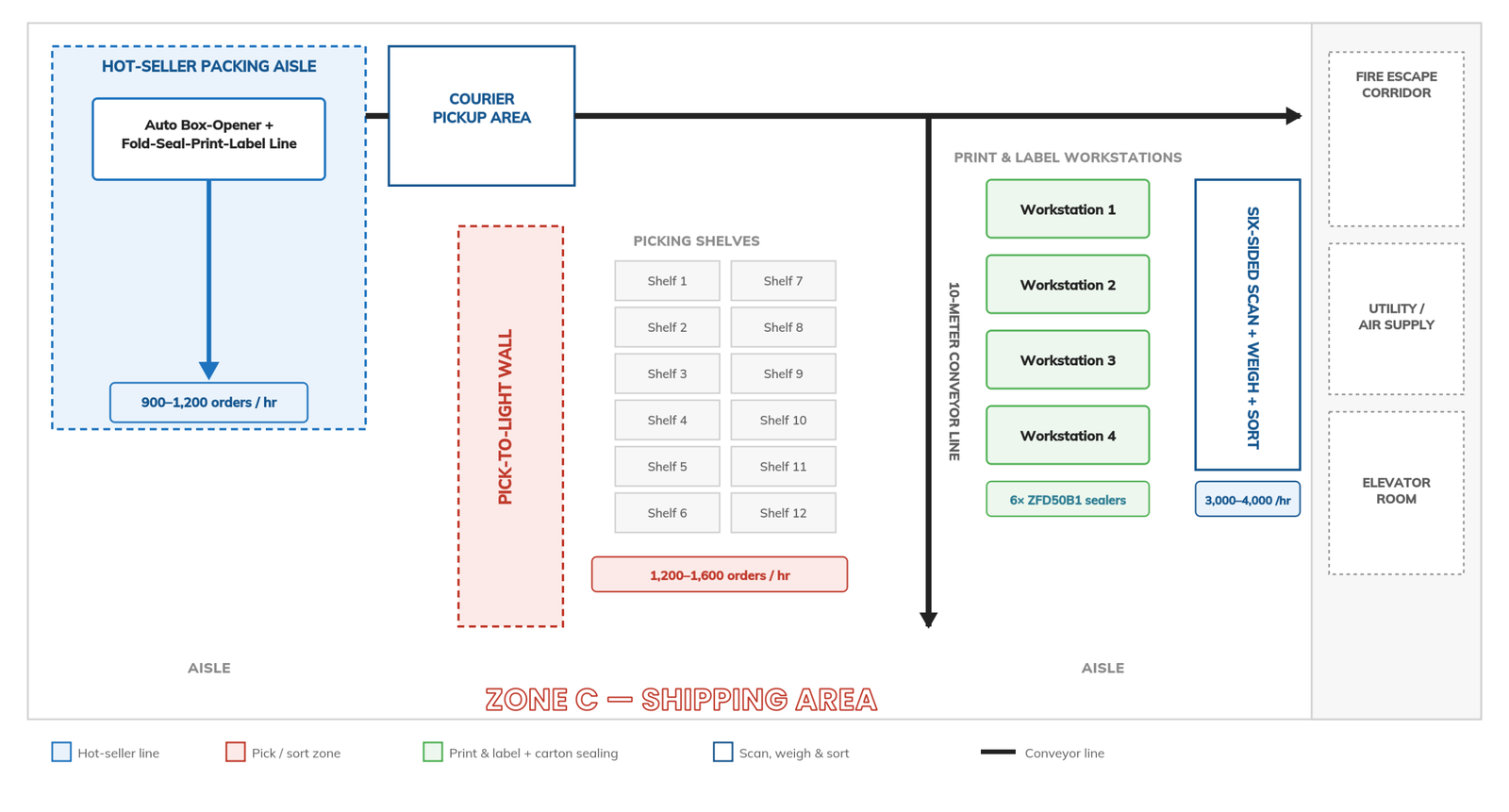
Rather than installing one universal machine, the warehouse deployed four purpose-built systems working together — each one matched to a specific slice of the order mix, and connected into a single packing line running through Zone C.
01Auto Box-Opening + Fold-Seal-Print-Label Line — Built for Hot-Sellers
For the 40% of orders that are repeat hot-sellers, two production lines handle the entire sequence automatically: opening the carton, folding and sealing it, printing the shipping label, and applying it — all without a manual touch point. Because hot-seller packaging is predictable and repetitive, this line is tuned purely for raw speed.
02A Right-Size Auto-Adjust Carton Sealer — Built for Single- and Multi-Item Orders
Six units of the YPX-ZFD50B1 Automatic Right-Size Carton Sealer with Print & Apply & PC handle the harder 50% of the order mix — single-item and multi-item orders that don't follow a predictable packaging pattern. The machine adjusts carton size automatically per order, then prints and applies the label in the same pass, replacing what had been the single slowest, most labor-intensive part of the floor.
03A Pick-to-Light Wall — Built for Multi-SKU Order Accuracy
Multi-item orders often pull from several SKUs at once, which is exactly where manual picking accuracy breaks down under volume. A pick-to-light wall guides pickers to the correct SKU and quantity for each order with lit indicators, then sorts picked items into the correct outbound order — raising both picking speed and accuracy for the order type most prone to mis-picks.
04Six-Sided Scan, Weigh, and Sort — Built for Outbound Verification
Before any package leaves Zone C, a six-sided scanning station reads every label, records the package weight, and routes it through a sorting system with dedicated outbound lanes — catching errors before they leave the building instead of after a customer complaint arrives.
The Results, By the Numbers
Four systems, one packing line, and a warehouse that no longer treats peak season as a crisis to survive.
What Changed Beyond Raw Throughput
A Process the Team Could Finally Standardize and Manage
Before automation, packing, picking, and shipping ran together without a clear structure — management had no reliable way to see where time was going. With each order type now routed to the equipment built for it, the floor runs on a repeatable process that can be measured, staffed, and adjusted ahead of the next promotional peak instead of reacted to during it.
Piece-Rate Pay Became Possible Once Output Was Trackable
With throughput now tracked by station, the warehouse rolled out a piece-rate compensation plan for packing staff — something that wasn't practical to run fairly under the old manual process. Output-based pay gave the team a direct incentive tied to a number everyone could see, and management a lever to manage labor efficiency instead of just headcount.
What Other High-SKU Maternity and Baby Brands Can Take From This
Signs a Single Machine Won't Be Enough for Your Order Mix
- Your order mix splits meaningfully between hot-sellers, single-item orders, and multi-item orders — not one uniform pattern.
- Multi-item orders regularly pull from several SKUs, and mis-picks show up disproportionately in that order type.
- Peak-season penalties keep recurring even after adding temporary labor.
- Management can't point to shipping data that explains exactly where orders slow down.
- Packing, picking, and quality checks still depend on the same small group of people to catch problems.
Questions to Ask When Scoping a Multi-Equipment Line
- What share of your daily orders are repeat hot-sellers versus single- or multi-item orders — and does each share justify its own equipment?
- Where in the current process do picking errors and packing delays actually originate?
- Can a right-size carton sealer handle your variable order types without a manual box-selection step?
- Does your ERP integrate with pick-to-light and scan-weigh-sort systems, or will that require custom development?
Frequently Asked Questions
Why does a maternity and baby brand need four different machines instead of one?
Because the order mix isn't uniform. Hot-sellers, single-item orders, and multi-item orders each stress a warehouse in a different way — repetitive packaging speed, right-size box variability, and multi-SKU picking accuracy are three separate problems. A single machine tuned for one of them tends to underperform on the other two, which is why this warehouse deployed a hot-seller line, a right-size carton sealer, a pick-to-light wall, and a scan-weigh-sort system as one connected line instead of one universal machine.
What order volume justifies a multi-equipment automated packing line?
This deployment was scoped for 15,000–20,000 orders a day with a mixed order profile. Below that volume, a single right-size carton sealer or pick-to-light wall may be enough on its own. The clearer signal isn't daily volume alone — it's whether your order mix genuinely spans multiple packaging patterns that no single machine handles well.
How does a right-size carton sealer handle both single- and multi-item orders?
The YPX-ZFD50B1 automatically adjusts carton dimensions per order based on the items being packed, then prints and applies the shipping label in the same pass — so single-item and multi-item orders can run through the same machine without a manual box-selection step or a changeover between styles.
Can a pick-to-light wall reduce mis-picks on multi-SKU orders?
Yes. A pick-to-light wall lights up the exact SKU and quantity a picker needs for each order, then sorts picked items into the correct outbound order — which is specifically where manual picking accuracy tends to break down once an order pulls from more than one SKU.
Does a system like this integrate with an existing ERP?
In this deployment, the packing line runs alongside the company's existing Jushuitan ERP, with order data flowing through each stage of the line. Integration scope varies by ERP and by how much of the pick-pack-ship data trail you want visible in one place, so it's worth confirming this specifically when scoping a similar project.
Next Step
Running 15,000+ Orders a Day Across a Mixed Order Profile?
Tell us your order mix and peak-season numbers — we'll help you scope which pieces of an automated line you actually need, not a one-size-fits-all install.
Talk to Our Team →This case study reflects a real customer deployment in maternity and baby e-commerce fulfillment. The company name and other identifying business details have been withheld at the customer's request. Order volumes, staffing levels, throughput, and equipment counts are as reported by the customer.

