
How Long Does It Take for an Auto Bagger to Pay for Itself?
YPXPACK PAYBACK ENGINEERING GUIDE — 2026
How Long Does It Take for an Auto Bagger to Pay for Itself?
A worked-example guide for warehouse and packaging teams sizing an automation budget · Auto Bagger · E-commerce Fulfillment
QUICK ANSWER
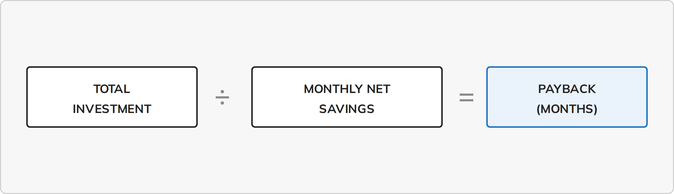
Most single-station auto baggers pay for themselves in 4 to 12 months. Where you land in that range depends on how many manual packers the machine replaces, your shift count, and your current burdened labor rate — the machine itself is a smaller variable than most buyers assume.
Replace two packers on one shift and you're closer to the fast end. Replace one packer on a partial shift and you're closer to the slow end. The formula below shows exactly why.
What Determines How Fast Your Auto Bagger Pays for Itself
Payback period isn't a fixed number stamped on the machine. It's the output of five variables, and you control four of them.
VAR — LABORLabor Cost Savings
Labor cost savings is the gap between what you pay packers today and what you pay to run the machine with fewer hands.
Take your current headcount times fully burdened hourly rate times hours per shift, then subtract the same math for however many operators the automated line needs. Do it monthly, not per bag.
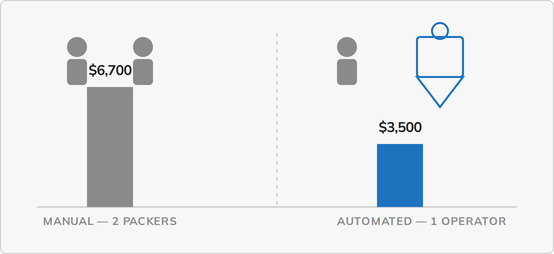
A tabletop auto bagger running 600-800 bags an hour outpaces an experienced manual packer averaging 200–300 bags an hour by roughly 3 to 4 to 1. That ratio is what lets one operator do the work of two or three packers.
VAR — THROUGHPUTThroughput & Output Gain
Throughput gain is the extra volume you can move through the same shift once cycle time stops depending on how fast a person's hands move.
Multiply the bags-per-hour difference between manual and automated output by your operating hours per day. That number either lets you cut overtime or take on more orders without adding a shift.
Manual bagging speed tops out around 200–300 bags an hour for a fast, experienced packer. A PLC-controlled tabletop bagger holds a consistent 600–800 bags an hour for an entire shift, with no fatigue curve.
VAR — MATERIALMaterial & Waste Reduction
Waste reduction is the film and bag material you stop losing to inconsistent hand cuts, misfeeds, and reseals.
Multiply your monthly film spend by the difference between your current waste percentage and what a PLC-controlled length and seal setting holds.
Manual bagging waste from mis-cuts and reseals commonly runs 3–6% of material. Automated length and seal control typically holds that under 1%.
VAR — INSTALLInstall & Facility Costs
Install cost is everything it takes to get the machine running before it saves you a dollar — and it belongs in the numerator, not left off the page.
Add machine price, freight and duties, any electrical work, a compressed-air line if the machine needs one, and floor or anchor prep.
A compressed-air-dependent bagger commonly adds $2,000–$6,000 in air-line installation alone. An all-electric machine skips that line item completely.
VAR — UPTIMEUptime & Maintenance
Uptime is the difference between the savings you calculate and the savings you actually collect.
Multiply your expected monthly downtime hours by the same hourly savings rate from your labor calculation — that's what a jam or a part-lead-time delay quietly costs you.
Machines built on proprietary or imported components can carry multi-week part lead times. Machines built on off-the-shelf, modular components typically cut that to a few days.
Calculate Your Auto Bagger Payback Period, Step by Step
Three steps turn that formula from an abstraction into a number you can defend in a budget meeting.
STEP 01Total Your Current Manual Costs
Before you can measure what automation saves, you need an honest number for what manual bagging costs you right now.
Add burdened labor (headcount × hourly rate × hours per shift), material waste, and any overtime or temp-labor premium from peak periods — all on a monthly basis.
STEP 02Estimate Your Automated Costs
This step builds the other half of the ledger: what it costs to run the machine every month, not just what it costs to buy.
Total investment (machine, freight, install) becomes your numerator. Monthly operating cost is one operator's wage, energy draw in kWh times your rate, and a maintenance reserve of roughly 2–3% of machine cost per year.
STEP 03Run the Formula on a Worked Example
Here's the math for a single-shift operation replacing two manual packers with one tabletop auto bagger and one operator.
| Cost item | Manual / mo | Automated / mo |
|---|---|---|
| Packing labor | $6,700 | $3,500 |
| Peak-season temp labor | $600 | $100 |
| Film & bag waste | $300 | $70 |
| Machine energy draw | — | $20 |
| Maintenance reserve | — | $35 |
| Total | $7,600 | $3,725 |
This example assumes a single 8-hour shift and a straightforward two-packer replacement — the fast end of the range. Add a second shift and this often lands under 2.5 months; replace one packer instead of two and it moves toward the 6–12 month end. Run your own numbers with the payback worksheet.
Typical Payback Timelines by Automation Tier
Where your project lands also depends on which tier of automation you're comparing against a plain manual station.
| Tier | Typical payback | Best for |
|---|---|---|
| Manual bagging station | No payback (baseline) | Under 500 bags/day, seasonal or trial volume |
| Tabletop auto bagger | 4–12 months | Single-line fulfillment, 1–3 packers replaced |
| High-speed / integrated line | 12–18 months | High-volume, multi-shift, 24/7 operations |
EDITOR'S PICKWhy YPXPACK's Auto Bagger Pays for Itself Faster
Two of the five variables above — install cost and uptime — are decided before the machine ever ships, by how it's built.
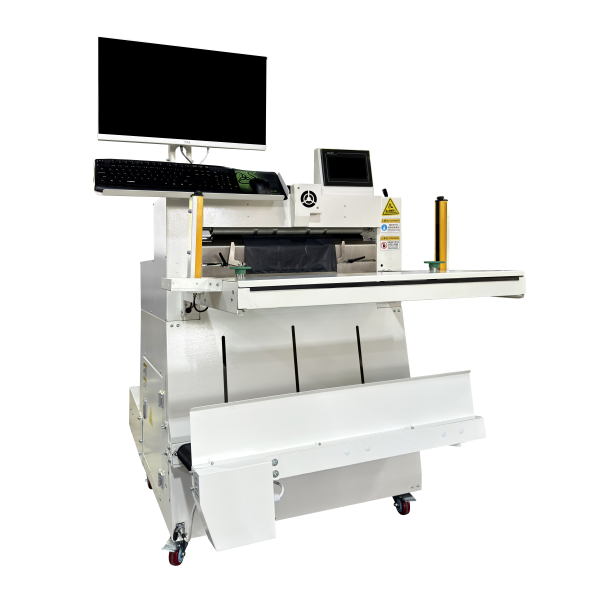
- All-electric design. No compressed-air line to install, which removes the single most common $2,000–$6,000 install-cost surprise from the Install & Facility variable above.
- 800W power draw. Roughly a quarter of what a comparable pneumatic system pulls, keeping the energy line in the worked example close to negligible.
- Direct-factory pricing. Built and shipped from our own Guangzhou facility with no distributor markup layered on top.
- Off-the-shelf modular components. The parts most likely to wear — seal bars, belts, sensors — are standard components, not proprietary parts with multi-week lead times.
- PLC job storage. Recall a stored bag-size preset in under 2 minutes instead of manually re-adjusting mechanical guides for 15–20 minutes per changeover.
Frequently Asked Questions
What counts as a "good" payback period for an auto bagger?
Most operations treat anything under 12 months as an easy approval and 12–24 months as a normal capital-equipment case. Beyond 24 months, most finance teams want the labor-market risk — rising wages, hiring difficulty — written into the justification, not just the raw payback number.
Does financing change the payback math?
Financing changes your cash flow, not your payback period. Payback still measures machine cost against monthly savings; financing just spreads that machine cost into smaller monthly payments, which can make the cash-flow case easier even when the payback-month number stays the same.
How does seasonality affect payback?
A machine that only earns its keep during three peak months a year has a longer real payback than the same machine running steady volume all year, even if the monthly savings number looks identical on paper. Model your slowest quarter, not your best week.
What's the fastest way to shorten your payback period?
Cut install cost and downtime first — they're the two variables you control entirely at the buying stage. An all-electric machine with off-the-shelf parts moves both numbers before you've packed a single bag.
A note on the numbers: figures in this guide are illustrative engineering estimates built from typical e-commerce fulfillment costs, not a quote for any specific project. Run your own numbers using the formula above, or request a project-specific figure from YPXPACK.

