
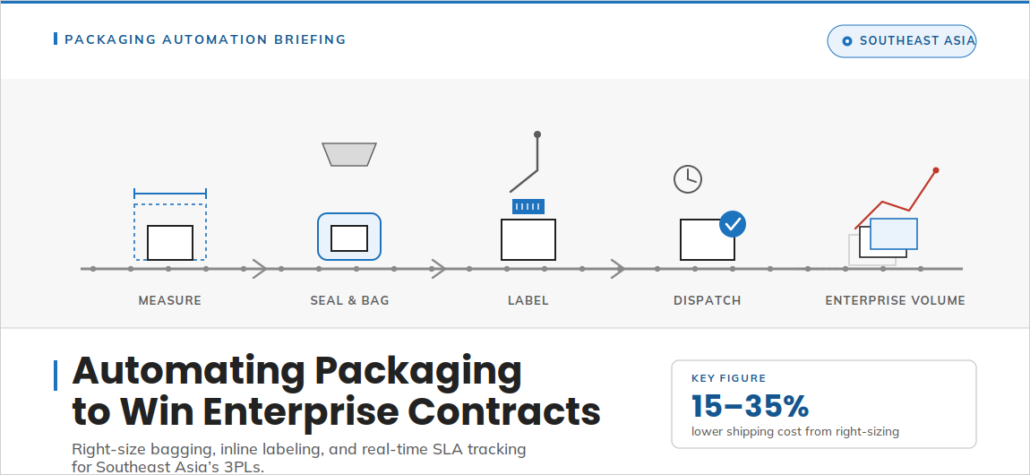
How Southeast Asian 3PLs Are Automating Packaging to Win Enterprise Contracts
Packaging Automation Briefing — Southeast Asia — 2026
How Southeast Asian 3PLs Are Automating Packaging to Win Enterprise Contracts
Southeast Asia's e-commerce platforms moved roughly $157.6 billion in merchandise in 2025, according to regional tracker Momentum Works, on track for $215–230 billion by the end of 2026. Every one of those orders has to be picked, boxed, and labeled inside a dispatch window the marketplace sets — not the 3PL. Packaging is quietly becoming the line item that decides who keeps an enterprise contract at renewal.
YPXPACK / Insights · Doc — PKG‑AUTO‑SEA‑26 · Region — Southeast Asia · Rev — 2026 · Read — 17 min
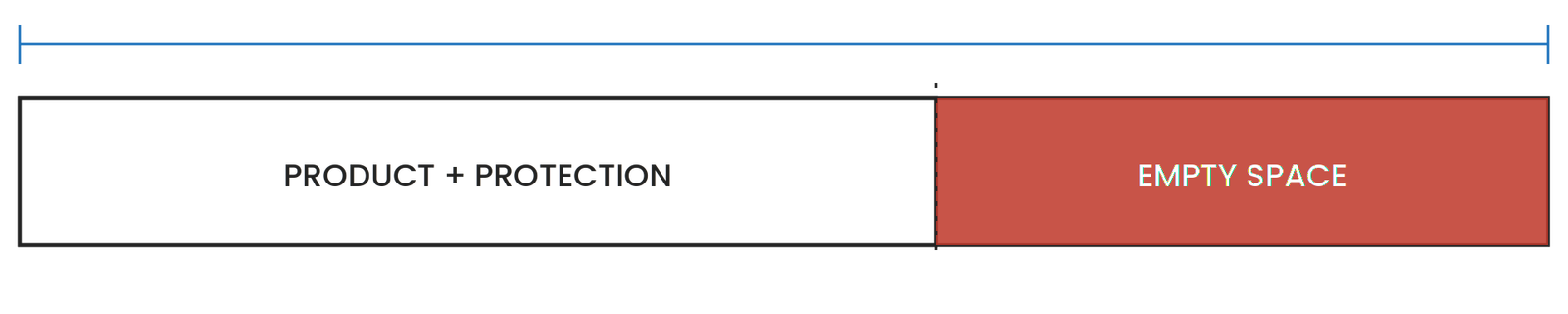
~40% average empty space per e-commerce shipment — Source: Packsize fulfillment measurement, via industry analysis
What "Packaging Automation" Means for Southeast Asian 3PLs Today
A manual pack station still runs plenty of Southeast Asian fulfillment centers: one operator picks a box from a limited size range, tapes it, stuffs void fill, weighs it, and hand-applies a label before it moves on. Packaging automation replaces that sequence with equipment that measures the order, seals it to a matched bag or carton spec, prints and applies the shipping label inline, and reports the result back to the warehouse system as it happens.
Enterprise brands increasingly write these capabilities directly into 3PL RFPs. Workforce shortages are a big reason why — roughly three-quarters of supply chain and logistics operations globally report notable staffing gaps, and packing stations are usually where that shortfall shows up first during a peak-season spike. A 3PL that can't hold pack-station throughput without adding headcount every quarter is a 3PL that struggles to hold its SLA line — and SLA misses are what get contracts re-bid.
What Shopee, TikTok Shop, Lazada, and LINE Shopping Actually Enforce
Before any of that gets solved, it's worth sitting with the problem. Southeast Asia's biggest marketplaces each run their own dispatch enforcement, and on three of the four, missing it doesn't just annoy a buyer — it throttles how many orders a seller is even allowed to take on the next cycle.
| Platform | Dispatch Requirement | If a Seller Misses It |
|---|---|---|
| Shopee | Same-day dispatch for orders before 2 PM; Late Shipment Rate under 5% | Penalty points → 28-day suspension of privileges, listing cap as low as 50 SKUs |
| TikTok Shop | Carrier scan within 2 business days; Late Dispatch Rate target ≤4%, hard cap 10% | Order volume capped at 90% of average, dropping to 70% and lower as LDR rises |
| Lazada | Ready-to-ship within 24 hrs, handover within 48 hrs; Late Shipment Rate capped at 2% (SG) | Search deprioritization within 7 days, escalating to listing suppression |
| LINE Shopping | No published platform-wide SLA; seller arranges courier pickup directly | Discretionary — cancellations logged for future enforcement, no fixed formula |
01Shopee: Penalty Points Tied Directly to Selling Privileges
Shopee ties its Late Shipment Rate (LSR) target directly to seller privileges. As of March 10, 2026, sellers must keep LSR under 5% — down from the roughly 10% threshold that applied through 2025 — and orders placed before 2 PM must ship the same day. Cross the line enough and Shopee's Seller Penalty Points system suspends privileges for 28 days: exclusion from marketing campaigns and a listing cap that can drop as low as 50 active SKUs, with repeat offenders facing an account freeze. Shopee's own calendar is built around double-date drops — 9.9, 10.10, 11.11, 12.12 — and 11.11 alone can multiply a normal day's order volume several times over; a pack line that can't hold same-day dispatch through that spike is a pack line that gets a seller demoted out of Shopee's own campaigns. See Shopee's Seller Penalty Points policy
02TikTok Shop: A Missed Dispatch Window Shrinks Next Week's Orders
TikTok Shop tightened its dispatch SLA on January 26, 2026: orders must get a carrier scan within 2 business days of entering "Awaiting Shipment," with the platform's own guidance flagging 4% as the healthy target for Late Dispatch Rate (LDR) and 10% as the hard enforcement line. The mechanism is unusually direct — once LDR crosses 10%, TikTok Shop caps the seller at 90% of their average daily order volume, dropping to 70% above 30% LDR and lower still beyond that. TikTok Shop's spikes are livestream-shaped rather than calendar-shaped: during Ramadan 2026's "Extra Exciting" campaign, sahur-hour transactions on the platform jumped 15-fold, and a single 12-hour celebrity livestream during the Raya season has generated over RM2.3 million in sales. A pack line built for an average week doesn't survive an hour like that — it shrinks how many orders TikTok Shop allocates on the next surge. See TikTok Shop's Late Dispatch Rate requirements
03Lazada: Search Ranking Is the Penalty
Lazada's Fast Fulfilment Rate expects items marked Ready-to-Ship within 24 hours and handed to a logistics partner within 48. Singapore sellers now operate under a Late Shipment Rate cap of 2% in 2026 — down from roughly 5% in 2024–2025 — and crossing it triggers search deprioritization within seven days, with repeated breaches escalating to listing suppression and a lockout from flash-deal placements. Recovery isn't instant either: it typically takes three consecutive clean 30-day windows to earn full standing back. Lazada's own signature event isn't a double-date at all — it's the March Birthday Sale, and the 2026 edition pushed platform-wide GMV up more than 3.5x across the region, with LazMall GMV up 6-fold and Malaysia alone seeing a 12x jump. See Lazada's fulfilment penalty thresholds
04LINE Shopping: No Formula, but No Buffer Either
LINE Shopping runs differently. Built as a chat-commerce layer inside the LINE app — used mostly by Thai sellers arranging their own courier pickup through LINE MAN or Thailand Post, with parcels capped at 40×40×40 cm for LINE MAN handling — it has no published platform-wide dispatch SLA or automated penalty-point formula like the other three. Its biggest volume moment is homegrown, too: Songkran, the mid-April Thai New Year festival, drives a seasonal buying wave that individual LINE Official Accounts and MyShop sellers manage on their own, without a platform-wide campaign engine behind it. LINE's own seller terms simply note that cancellations get logged "to consider punishing the Seller in the future," leaving enforcement discretionary rather than numeric. That doesn't mean the bar is lower: without a platform SLA buffer, an inconsistent pack process shows up directly in buyer chat and seller ratings, with no appeals process to fall back on. See LINE Shopping's seller terms
Line up all four and a pattern holds: every platform that publishes a formal SLA has tightened it in the last two years, not loosened it, and three of the four convert a missed dispatch window directly into a smaller order allocation — a self-reinforcing cycle where under-capacity during one peak shrinks the volume a seller earns on the next. A 3PL that can only hold its numbers on an average day isn't a safe bet for an enterprise contract; the platforms themselves have built the penalty math to expose exactly that gap. Stable, forecastable throughput on a normal week, plus headroom to absorb Shopee's 11.11, a TikTok Shop livestream that outsells a normal month in twelve hours, or Lazada's Birthday Sale without the SLA sliding, is what marketplace enforcement actually selects for. Closing that gap starts on the pack-and-ship floor — with five specific capabilities that turn a marketplace's dispatch clock from a liability into a competitive edge.
5 Ways Southeast Asian 3PLs Are Automating Packaging to Win Enterprise Contracts
These are the five capabilities showing up most often on the pack-and-ship floor of Southeast Asian fulfillment centers chasing enterprise volume — and the specific thing to check for each one before it shows up as a gap in a bid.
01Right-Size Auto-Bagging and Carton Sealing
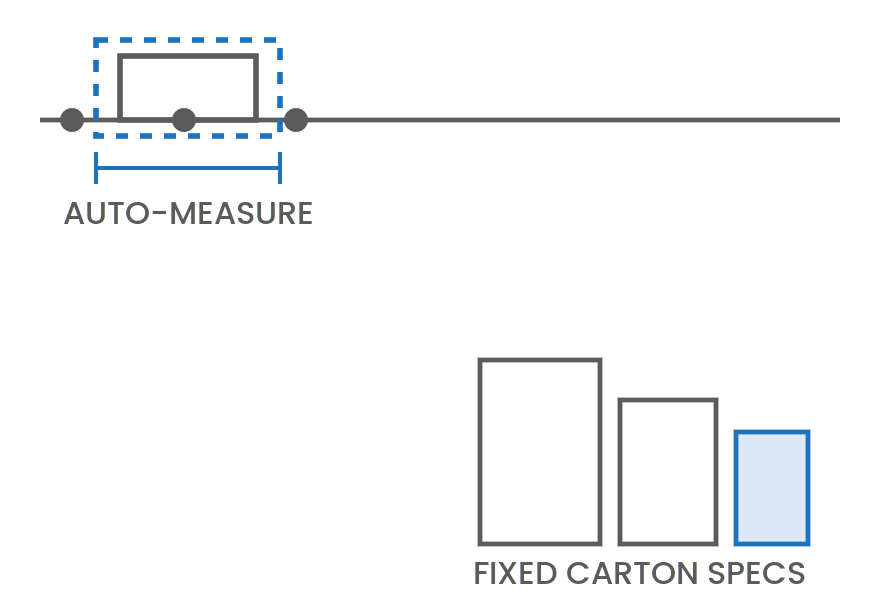
Southeast Asian 3PLs are swapping single-size pack stations for two connected machine types. Auto-baggers measure each item's length as it crosses the conveyor and seal a poly bag cut to that exact length, forming and sealing a mailer around every item in real time. Carton sealers work differently: rather than reshaping a box on the fly, they run a defined set of fixed carton specifications sized to cover a merchant's multi-SKU range, and the sealer automatically adjusts fold, seal, and label position to whichever preset spec the order calls for.
The gap this closes is real — fulfillment measurements put the average e-commerce shipment at roughly 40% air, and right-sizing programs typically cut shipping spend 15 to 35 percent by pulling that empty space, and its dimensional-weight surcharge, back out of every parcel.
For 3PLs bidding on enterprise volume, the number that matters isn't just bags-per-minute — it's how many carton specs a sealer can hold in rotation without a manual changeover, since a brand with 40 SKUs across three size tiers needs a line that switches specs in seconds, not minutes. See a right-size auto-bagger spec sheet
02Integrated Print-and-Apply Labeling
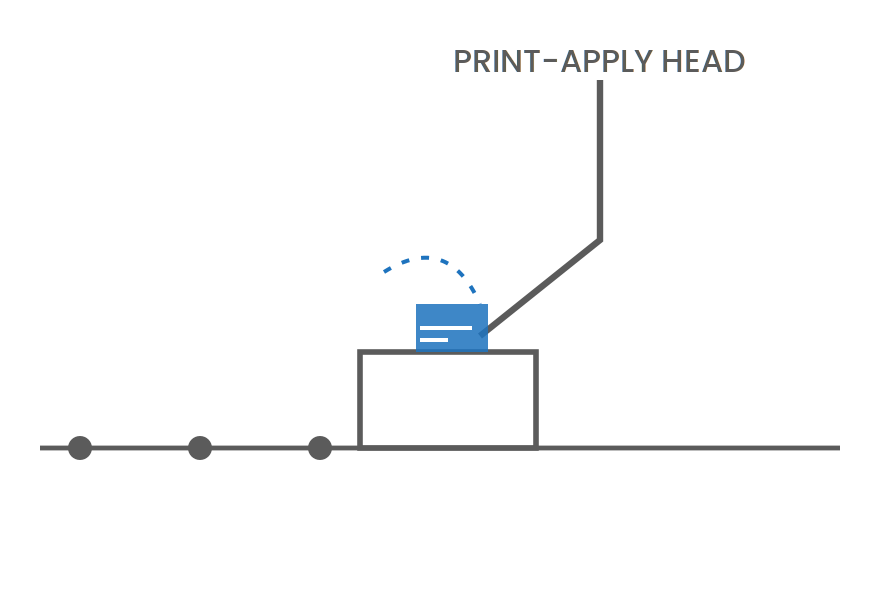
Labeling is where a lot of enterprise SLA misses actually originate. A picker attaches the wrong carrier label, or a barcode prints slightly smudged, and the parcel gets flagged at the carrier hub instead of the pack station — by then it has already blown the dispatch window. Print-and-apply automation closes that gap by printing the label and applying it to the package at the same point the carton or bag is sealed, using the weight and dimension data the machine just captured.
This is typically built directly into the sealing station: a print-and-apply head mounted at the seal point on a right-size auto-bagger, or a standalone applicator on a line that already runs a separate sealer. Either way, the label goes on inline, with no separate labeling station and no second handling touch where an error can creep in. See automated packaging machine spec sheet about print-and-apply information
When evaluating this capability, ask whether "automated labeling" actually means inline print-and-apply, or just a barcode scanner at a manual station — the two get marketed almost identically, but only one removes the touch point that causes mislabeling in the first place.
03Robotics and Conveyor-Integrated Pack Lines
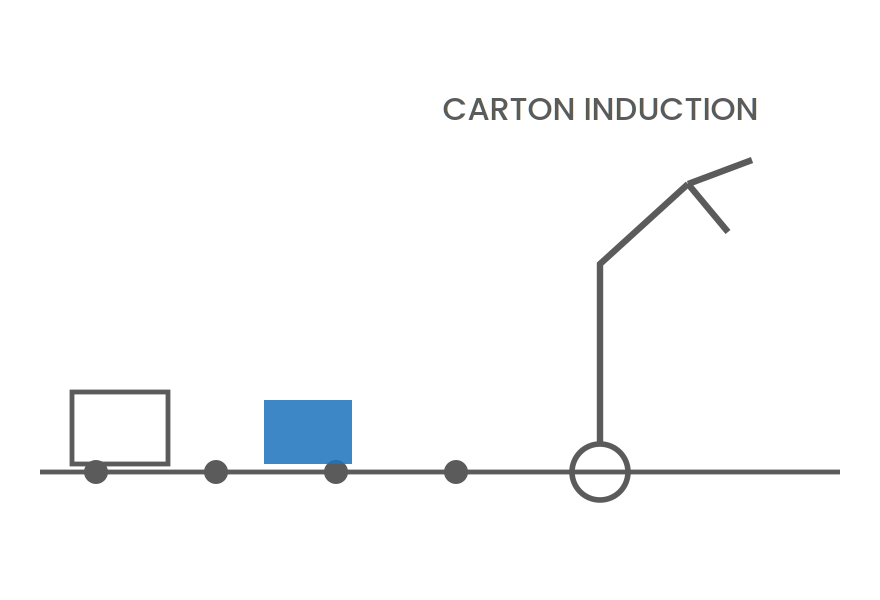
Robotics is moving into the packaging line itself, not just picking and put-away. Conveyor-fed carton induction, robotic arms that load cartons onto a sealer, and automated guided vehicles that clear finished parcels off the line are now common on the pack-and-ship side of Southeast Asian fulfillment centers, not just in the aisles.
The investment case is straightforward: the global warehouse robotics market moved from roughly $9.3 billion in 2025 toward a projected $21 billion by 2030, a 17.7% annual growth rate, according to Mordor Intelligence — and Robots-as-a-Service contracts are a big reason mid-tier 3PLs can now afford a slice of it, turning a capital purchase into a monthly operating cost instead of a lump-sum investment.
For a 3PL evaluating a packaging-line upgrade, the robotics question isn't "do we need a robot arm" — it's whether the bagger or sealer under consideration is built to sit on a conveyor and receive product automatically, or whether it needs a custom retrofit to connect to anything already running on the floor. The second option adds months to a deployment enterprise brands aren't willing to wait for.
04Compliance-Ready, Right-Sized Materials
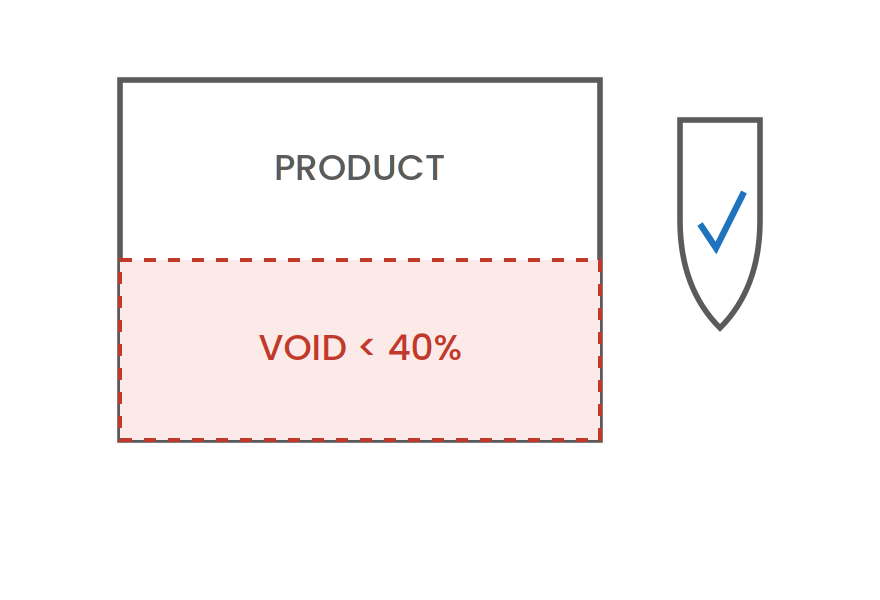
Packaging-waste regulation is no longer a Europe-only conversation for 3PLs chasing enterprise contracts. The EU's Packaging and Packaging Waste Regulation caps empty space inside a shipped parcel at 40% starting August 12, 2026, and enterprise brands that sell into the EU are already pushing that same standard down into their global packaging specs — including orders fulfilled out of Southeast Asian warehouses for cross-border buyers.
Right-size equipment is what makes that standard auditable instead of aspirational. A bagger that forms each bag to the item's measured length, or a sealer running a tight range of carton specs instead of three oversized default boxes, produces an empty-space ratio a compliance team can actually report on. A packer eyeballing box selection by hand cannot.
When a 3PL is being evaluated against this requirement, the equipment question is whether the packaging line logs dimension and void-space data per order, or whether "compliant packaging" is really just a policy on a wall that depends on an operator remembering to follow it.
05Real-Time Data and SLA Tracking on the Pack Line
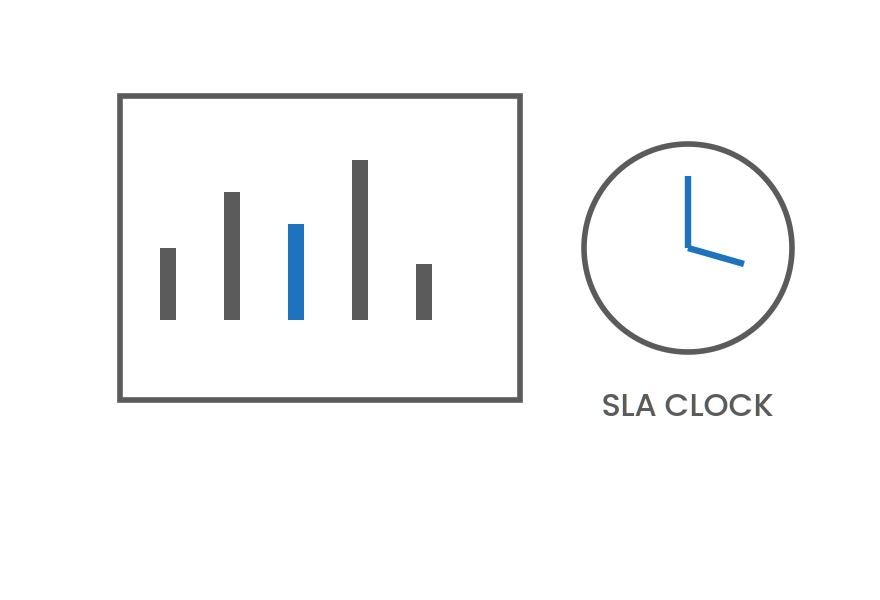
Marketplace dispatch windows keep compressing. Shopee's in-house carrier now moves half of the platform's Southeast Asian parcels in under two days, and the region's express-parcel volume is on track to jump from roughly 15 billion parcels in 2023 to nearly 38 billion by 2029, according to Mordor Intelligence. A pack line that reports its own throughput only at shift-change can't catch a slipping SLA until it's already missed.
Connected packaging equipment changes that. A touchscreen interface with stored job settings logs cycle counts and dispatch times as the line runs, feeding that data into the warehouse or order-management system so a supervisor sees the countdown to a marketplace's cutoff time the same way the equipment does — in real time, not at the end of the shift.
When scoping this for an enterprise contract, the question worth asking a vendor is blunt: does the packaging line's data reach the WMS on its own, or does a supervisor have to walk the floor and manually reconcile a count against what the system expects? The second version is the one that misses SLAs during a mega-sale spike.
Manual vs. Automated Packaging: What Changes for Enterprise Contracts
The gap between a manual pack station and an automated line isn't marginal once it's laid out side by side.
| Factor | Manual Packaging | Automated Packaging |
|---|---|---|
| Throughput per station | Scales 1:1 with headcount | Commonly 20+ items/min per line, headcount-independent |
| Box or bag selection | Picked by eye from a few stock sizes | Auto-measured, matched to item or fixed right-size spec |
| Labeling | Separate manual station, error-prone | Inline print-and-apply at the seal point |
| Empty-space ratio | Often 30–40%+ void space | Audit-ready, engineered toward the EU PPWR's 40% cap |
| SLA visibility | Manual tally at shift change | Real-time dispatch data into WMS/OMS |
| Peak-season scaling | Requires proportional headcount hiring | Absorbs volume spikes without 1:1 headcount growth |
What Enterprise E-Commerce Brands Evaluate Before Signing a Southeast Asian 3PL
Enterprise procurement teams score 3PL proposals against a fairly consistent checklist once packaging automation is on the table. Five items come up in nearly every RFP.
- Dispatch SLA under peak load. Not the average day — what happens during Shopee's 11.11, a TikTok Shop livestream surge, Lazada's Birthday Sale, or Songkran, when order volume can run several times normal, against the marketplace-specific thresholds covered above.
- Certifications and compliance documentation. CE marking and ISO 9001-aligned build quality on the equipment itself, plus evidence the line can hit empty-space and material rules like the EU's PPWR for cross-border orders.
- Scalability without a hiring spike. Whether the 3PL can absorb 3–5x order volume on a mega-sale weekend without adding headcount at the same ratio.
- System integration. Whether packaging-line data — cycle counts, dispatch times, error rates — flows into the WMS/OMS automatically, or has to be manually reconciled and reported.
- After-sales support and uptime. A packaging line down for three days during peak season is a missed SLA regardless of how fast it normally runs, so vendor service response time is part of the evaluation, not an afterthought.
None of this shows up as a single line item labeled "packaging automation" in an RFP. It shows up scattered across the SLA, compliance, and technology sections — which is exactly why it's easy for a 3PL to underinvest in until a lost bid makes the gap obvious.
How the Right Packaging Equipment Fits a Winning Line
Everything above is a capability list, not a shopping list — but a 3PL evaluating where to spend a packaging-automation budget eventually has to pick equipment, and it's worth being specific about what that looks like in practice.
YPXPACK is a direct-factory manufacturer that's been building this equipment since 2016, and its production line is built around the same two mechanisms covered above: right-size auto-baggers that measure and form a matched bag per item, and carton sealers that run a defined range of right-size box specs for multi-SKU orders, with a print-and-apply head integrated at the seal point on either line. The build is CE-certified and ISO 9001-aligned, and the factory backs it with 24-hour after-sales support — relevant for a 3PL that can't afford a packaging line down during a mega-sale weekend.
Worth being direct about the tradeoff, too. YPXPACK builds the packaging hardware layer — the bagger, the sealer, the label applicator — not a WMS or TMS software stack, so it's one piece of the automation stack covered here, not all of it. And because the factory is based in Guangzhou, freight lead time needs to be built into a rollout plan rather than treated as a same-week domestic swap. That makes it a fit for a 3PL planning a packaging-line upgrade ahead of a contract renewal, not a same-week emergency replacement.
| Manufacturer | Direct factory, est. 2016 |
|---|---|
| Core lines | Right-size auto-baggers, carton sealers |
| Labeling | Integrated print-and-apply |
| Customization | Full OEM engineering |
| Build standard | CE / ISO 9001-aligned |
| Support | 24-hour after-sales |
Frequently Asked Questions
Do Shopee, TikTok Shop, Lazada, and LINE Shopping all enforce the same shipping SLA?
No. Shopee requires same-day dispatch for orders before 2 PM and caps Late Shipment Rate at 5%. TikTok Shop requires a carrier scan within 2 business days and enforces a 10% Late Dispatch Rate ceiling, with order-volume caps that tighten as the rate rises. Lazada expects Ready-to-Ship within 24 hours and handover within 48, with a 2% Late Shipment Rate cap in Singapore. LINE Shopping has no published platform-wide SLA at all — sellers arrange their own courier pickup, and LINE logs cancellations for discretionary future action rather than applying a fixed formula. A 3PL serving multiple platforms needs a packaging line that can hold the tightest of these numbers, not just the average.
What does packaging automation cost for a mid-size Southeast Asian fulfillment center?
There's no single number, because the cost swings on order profile — throughput needed, how many bag or carton size variants a line has to run, and whether the equipment needs OEM customization for unusual SKUs. What's more useful than a quote range is the payback math: weigh equipment cost against labor hours saved per shift plus the dimensional-weight savings from right-sizing, which industry analysis puts at 15 to 35 percent of affected shipping spend. For a fulfillment center where a pack station is already a bottleneck during peak weeks, that payback window is usually measured in months, not years — worth asking any equipment vendor to model against your actual order data rather than a generic estimate.
How fast can a 3PL roll out automated packaging without disrupting live enterprise contracts?
Most 3PLs run automated and manual pack stations in parallel rather than doing a hard cutover — the new line takes a portion of order volume, often starting with a single client or SKU category, while manual stations keep handling the rest, so a hiccup during commissioning never touches the full order book. Once the automated line is hitting its rated throughput and dispatch accuracy consistently, volume shifts over in stages. For equipment sourced from an overseas factory, the bigger scheduling variable is usually freight and installation lead time rather than the rollout itself, so that's the number worth locking down early with a vendor.
Do enterprise e-commerce brands require specific packaging certifications from their 3PL?
Increasingly, yes. Enterprise brands selling across multiple markets tend to standardize their packaging specs globally, which means a Southeast Asian 3PL fulfilling their cross-border orders can get held to the same bar as a European or North American facility — CE marking and ISO 9001-aligned manufacturing on the equipment itself, plus documented compliance with packaging-waste rules like the EU's PPWR for anything shipping into that market. It's worth confirming certification paperwork with any equipment vendor before it becomes a line item a brand's compliance team flags during an audit.
Can one automated packaging line handle multiple SKU sizes for a single enterprise client?
Yes, within a defined range. An auto-bagger measures each item and forms a bag to that length on the fly, so it naturally handles size variation without a changeover. A carton sealer instead needs the right set of fixed carton specs loaded for that client's SKU spread — the line switches between them per order, but someone has to map the client's product range to a spec set during onboarding. That mapping step is usually the actual bottleneck in multi-SKU setups, not the equipment's raw capability.
Figures cited are drawn from named third-party analyst and industry sources as of publication and are provided for planning context, not as guarantees of cost or performance for any specific operation.
