
How to Scale Your Fulfillment Line Before a Major Sales Campaign 2026
PRE-CAMPAIGN OPERATIONS PLAYBOOK · 2026
How to Scale Your Fulfillment Line Before a Major Sales Campaign
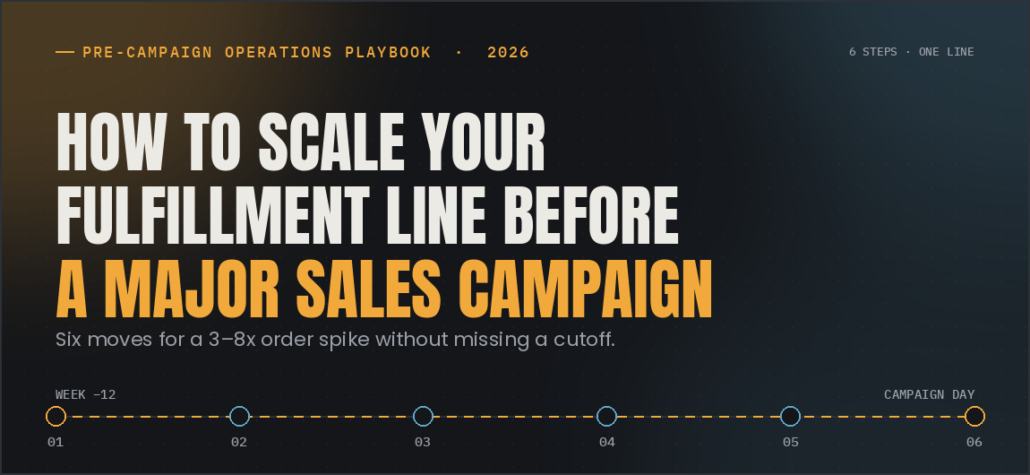
Six moves that turn a fulfillment operation built for a normal week into one that can take a 3–8x order spike without missing a cutoff.
A fulfillment line that runs fine on a normal Tuesday will crack under a major sales campaign's volume. Stockouts, mis-picked orders, and blown carrier cutoffs don't show up until the campaign is already live — and by then, the fix is expensive and public.
This playbook walks through the six moves that turn a fragile line into one that holds up at 3–8x volume, in the order you actually need to run them.
QUICK REFERENCE
Peak-Readiness Checklist
Six deadlines, counted backward from campaign day zero. Miss the early ones and the later steps get compressed into a scramble.
| Task | Do‑By | Owner |
|---|---|---|
| Lock demand forecast & inventory plan | −10 to −12 wks | Ops / Planning lead |
| Finalize warehouse zoning & pack-station layout | −8 to −10 wks | Warehouse manager |
| Order or reconfigure packing / labeling automation | −8 to −12 wks | Ops / Procurement |
| Post seasonal staffing plan & start cross-training | −6 to −8 wks | HR / Warehouse manager |
| Confirm carrier capacity & cutoff calendar | −4 to −6 wks | Logistics lead |
| Run full-volume dry run & close out bottlenecks | −2 wks | Ops lead |
THE PLAYBOOK
The 6-Step Fulfillment Scale-Up Playbook
Each step builds on the one before it — a fast pack station behind a bad layout still bottlenecks, and trained staff without confirmed carrier capacity still miss cutoffs. Run them in order.
Objective — Build a volume forecast for the campaign window and reverse-engineer every downstream deadline — staffing, equipment orders, carrier bookings — from it.
Prerequisites — At least one prior peak-season sales history. Less than 12 months old? Use category benchmarks from your sales platform as a stand-in and pad by 20–30%.
Do this
- Pull last year's campaign-week order volume and compare it to a normal week. Know your own multiplier — DTC brands commonly see 3–8x depending on category, but a generic number will mislead every step after this one.
- Segment the forecast by SKU, not just total orders. Your top 20 SKUs by campaign-week volume usually drive 70–80% of picks and deserve dedicated slotting.
- Build backward from campaign day zero: equipment orders at week −12, staffing posted at week −8, carrier capacity confirmed at week −6, dry run at week −2.
- Set a trigger threshold — for example, "if daily orders exceed 2x baseline for 3 consecutive days, activate the surge plan" — so scaling isn't a judgment call made mid-campaign.
Where this breaks
Forecasting off last year's total revenue instead of order count inflates projections whenever average order value shifts. Treating every SKU as equally likely to spike is the second most common miss — one promoted item can single-handedly overload a pick zone sized for normal distribution.
Verify
You can state, in writing, your projected peak-day order count, your top 10 SKUs by expected volume, and the calendar date each downstream deadline falls on. If any of those three is a guess, the forecast isn't finished.
Objective — Reconfigure zoning and pack-station flow so picking and packing don't collide with each other once headcount and volume both climb.
Prerequisites — Step 1's SKU-level forecast. You need to know what to slot, not just how much floor space you'll need.
Do this
- Move your forecasted top 20 SKUs into a dedicated fast-pick zone near packing — this cuts travel time per pick significantly versus scattered slotting.
- Convert at least one aisle or bay into overflow staging for inbound restocks, so receiving doesn't block pick paths mid-shift.
- Add a second (or third) pack station if your current one is the bottleneck. A single station capping out around 60–90 orders per hour per packer is normal — multiply by your target daily volume to see if one station covers it.
- Establish one-way pedestrian and cart flow through pick and pack zones. Bidirectional aisles are a common source of collisions once headcount doubles for peak.
Where this breaks
Adding headcount to a layout that was never redesigned just crowds more people into the same bottleneck. Skipping a dedicated overflow zone means receiving and picking compete for the same aisle space right when both are busiest.
Verify
Walk the floor with the revised layout marked and time a single order from pick to pack-complete. If travel time hasn't dropped versus your baseline walk, the zoning change didn't work.
Objective — Remove the packing and labeling bottleneck — usually the tightest chokepoint once picking is optimized — with equipment sized to your actual peak throughput.
Prerequisites — A pack-station throughput baseline from Step 2, and a decision on box or mailer profile for your top SKUs.
Do this
- Calculate your required packs-per-hour at peak — peak-day orders divided by operating hours and number of pack lines — before shopping for equipment. Size the machine to the number, not the sales pitch.
- For poly-mailer-heavy catalogs, an all-electric apply-and-seal bagging machine removes the slowest manual step — folding and heat-sealing — and can push a single line well past manual packer throughput.
- For carton-based SKUs, pair a top-and-bottom taping machine with an inline label applicator, so sealing and labeling happen in one pass instead of two separate manual stations.
- Order 8–12 weeks before campaign day zero. This is the one step in this playbook with real lead time — custom-configured machines need that runway, and CE-certified units go through QA/QC before they leave the factory.
Where this breaks
Buying automation sized for your average week instead of your peak week: the machine sits underused ten months a year and still can't clear the surge. Ordering equipment inside the 4–6 week window and hoping for expedited freight is the single most common reason automation arrives after the campaign, not before it.
Verify
Run a timed test batch on the installed machine at your target SKU mix. If packs-per-hour on the line matches or beats your Step 3 calculation, you're ready; if not, adjust operator staffing on the line before campaign day, not during it.
A note on the equipment itself — This is the one step where a purpose-built supplier matters more than a generic listing. YPXPACK engineers auto-baggers, carton sealers, and label applicators to your specific box or mailer spec rather than shipping a one-size unit, backs them with CE certification and in-house QA/QC, and offers 24-hour after-sales support, including overseas, for when a line goes down mid-peak. The tradeoff worth knowing: YPXPACK sells the equipment, not the labor or floor space to run it — you still need Steps 2 and 4 to get the full benefit, and the lead time means this isn't a fix you can make the week of the campaign.
Objective — Have enough trained people in the right roles on peak days, without overstaffing every slow week around them.
Prerequisites — Step 1's peak-day volume number and Step 3's packs-per-hour capacity. A staffing plan without those two lands as a guess.
Do this
- Cross-train every full-time picker on at least one packing task, and vice versa. Picking and packing rarely spike evenly on the same day, and cross-trained staff can flex to wherever the queue is building.
- Post seasonal roles by week −8. Agencies and applicants both move slower during the exact weeks every other warehouse in your market is also hiring.
- Stagger shifts so pack-station headcount peaks one to two hours after picking headcount — packing backs up fast when both start cold at the same time.
- Assign one floor lead per zone whose only job during peak hours is clearing bottlenecks, not working a station themselves.
Where this breaks
Hiring the same headcount for every day of the campaign window instead of matching shift size to the daily forecast wastes labor budget on slower days and still underserves the peak day. Skipping cross-training leaves packers idle during a picking surge, or pickers drowning during a packing surge.
Verify
Every seasonal hire has completed at least one full shadow shift before campaign week, and your shift schedule matches Step 1's daily volume curve — not a flat headcount across every day.
Objective — Guarantee outbound capacity and set automated routing rules so shipping doesn't become the bottleneck right after packing clears.
Prerequisites — Step 1's peak-day order count and your current carrier contract terms.
Do this
- Confirm your primary carrier's volume commitment and cutoff calendar for the campaign window by week −6. Capacity isn't unlimited, and unconfirmed volume can get bumped during the carrier's own peak.
- Add a secondary carrier or regional partner for overflow, so one carrier's daily cap doesn't cap your entire outbound flow.
- Set automated shipping rules — carrier and service selection by weight, zone, and cost — ahead of time. Manual carrier selection at pack-and-ship speed is a common source of both delay and margin loss during peak.
- Publish your last-order-by date to customers before the campaign starts, tied to your actual carrier cutoffs, not an optimistic guess.
Where this breaks
Assuming last year's carrier capacity still applies: carriers reallocate capacity across customers every peak season, and yours can shrink even if your order volume grows. Confusing a carrier's pickup cutoff with its published delivery promise is a frequent source of missed campaign-day shipments.
Verify
Carrier capacity and cutoff confirmation exists in writing, and your automated routing rules have been tested against a batch of sample orders to confirm the correct service is selected before the campaign, not discovered mid-peak.
Objective — Prove the whole line — forecast, layout, automation, staffing, and shipping — holds together at peak volume before the campaign is live and customers are watching.
Prerequisites — Steps 1–5 complete: layout finalized, equipment installed, seasonal staff at least partially trained, carrier rules configured.
Do this
- Schedule the dry run 10–14 days before campaign day — early enough to fix what breaks, late enough that staffing and equipment are close to final.
- Simulate your Step 1 peak-day order count using real historical or synthetic orders pushed through the actual WMS, not a tabletop walkthrough.
- Time every stage — pick, pack, label, ship — and compare against your Step 2 and Step 3 throughput targets.
- Log every failure point — a jammed label applicator, a picker misrouted to the wrong zone, a shipping rule that mis-selected carrier — and assign an owner and fix date before the campaign starts.
Where this breaks
Running the dry run at 50–60% of forecasted volume "to be safe" hides the exact bottlenecks that only surface at full load. Treating the dry run as a pass-or-fail event instead of a punch list means real issues get noted but never actually fixed before campaign day.
Verify
Re-run the dry run, or a shortened version, after fixes are made. A line that's ready shows steady throughput at full simulated volume with no unresolved items left on the failure list.
FAQ
Common Questions on Scaling Before a Campaign
Straight answers to the questions that come up most once a scale-up plan is underway.
How many weeks before a major sales campaign should I start scaling my fulfillment line?
What does packing-line automation typically cost, and is it worth it for one campaign?
How far in advance should I bring on seasonal staff?
What order-accuracy rate should I be targeting before peak?
Do I need a 3PL, or can I scale a fulfillment line in-house?
Ready for a Major Sales Campaign?
None of these six steps work in isolation — a fast pack station behind a slow layout still bottlenecks, and a trained staff without carrier capacity still misses cutoffs. Work through them in order, starting with the forecast, and treat the dry run as non-negotiable.
If packing and labeling is the step you're least confident in, YPXPACK builds and configures automation lines to your SKU mix, with CE-certified QA and 24-hour after-sales support — just order early enough to beat the lead time.
Fulfillment Scale-Up Playbook / 2026 — Six Steps, One Line.

