
Tabletop Auto Bagger vs Manual Packaging: Real Cost Comparison for E-Commerce Fulfillment
Cost Analysis · E-Commerce Fulfillment Ops
Tabletop Auto Bagger vs Manual Packaging: Real Cost Comparison for E-Commerce Fulfillment
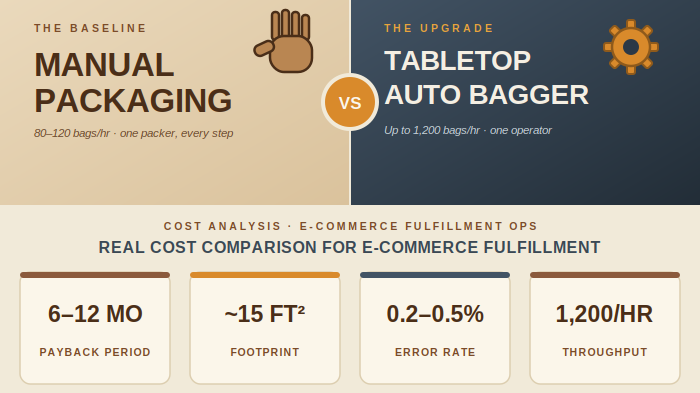
Every order that crosses a pack station carries a labor cost, a material cost, and a probability of coming back damaged or mislabeled. Below roughly 1,000–3,000 orders a day, hand-packing usually wins on total cost. Cross that line and the math flips — here's exactly where, with real labor rates, error rates, and payback numbers.
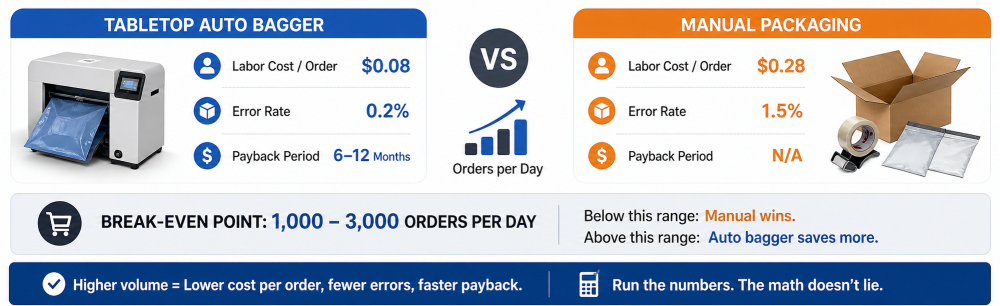
FIG. 1 — Manual pack sequence vs. YPXPACK tabletop auto bagger, same order
Quick Comparison: Tabletop Auto Bagger vs Manual Packaging
Here's the topline before the walkthrough. Full model specs and links to YPXPACK's tabletop auto bagger lineup are in the cost breakdown below.
| Factor | Tabletop Auto Bagger | Manual Packaging |
|---|---|---|
| Upfront cost | $3,000–$8,000 (model-dependent) | $500–$3,000 (table, sealer, scale) |
| Labor headcount | 1 operator / 5,000+ orders/day | 1 packer / 800–1,000 orders/day |
| Throughput | 600–1,200 bags/hr rated | 80–120 bags/hr per packer |
| Error / scrap rate | 0.2%–0.5% | 1.5%–3% |
| Footprint | ~14–15 sq ft (tabletop) | 40–60 sq ft per station |
| Payback period | 6–12 months typical | N/A — no capital outlay |
Manual Packaging vs Tabletop Auto Bagger: What's the Difference
Manual packing is a person moving through a fixed sequence — verify the pick, open the bag, insert, seal, label, set aside — at whatever pace fatigue and SKU complexity allow. A tabletop auto bagger automates the middle of that sequence: it measures, opens, seals, and optionally prints and applies the label, while a person still handles pick verification and infeed. YPXPACK's engineering team builds around that division of labor rather than trying to remove the operator entirely — which is why headcount drops to one per machine instead of to zero.
Cost Breakdown: Tabletop Auto Bagger vs Manual Packaging
The numbers below assume a single-shift e-commerce pack station running standard poly-mailer orders — scale up for multi-shift operations or heavier product mixes.
01Manual Packaging Costs
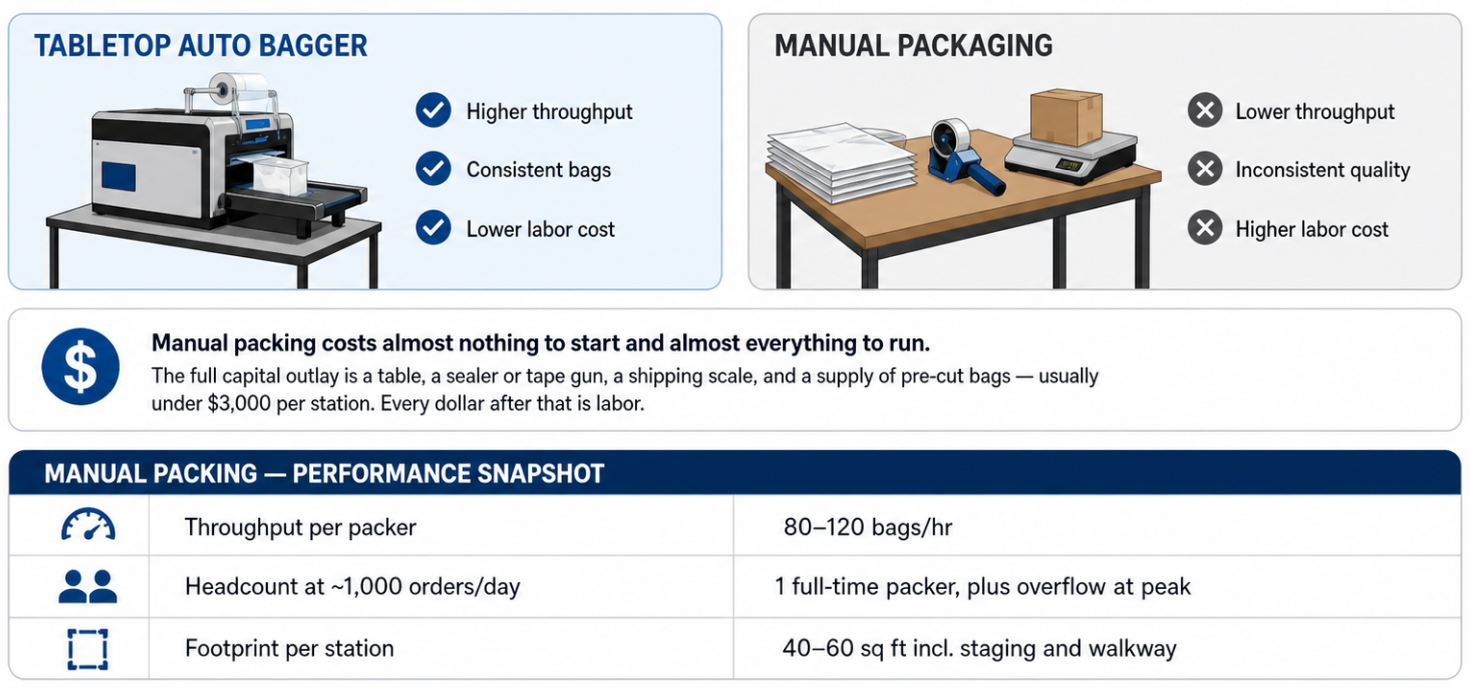
Manual packing costs almost nothing to start and almost everything to run. The full capital outlay is a table, a sealer or tape gun, a shipping scale, and a supply of pre-cut bags — usually under $3,000 per station. Every dollar after that is labor.
| Throughput per packer | 80–120 bags/hr |
|---|---|
| Headcount at ~1,000 orders/day | 1 full-time packer, plus overflow at peak |
| Footprint per station | 40–60 sq ft incl. staging and walkway |
Real strengths
- Zero capital risk — no equipment to depreciate or resell if volume drops
- Handles irregular SKUs (odd shapes, multi-packs, fragile items) without a bag-size limit or changeover
- Deployable in days: hire, hand someone a tape gun, station is live the same week
Honest weaknesses
- Fully loaded labor runs $26–29/hr per packer — the national median wage for packaging and material-handling roles is $20–22/hr, per BLS data, plus standard payroll and benefits burden — and it scales linearly with every order added
- Error rate climbs under peak-season fatigue: mis-sized bags, wrinkled seals, and wrong labels commonly run 1.5%–3% of orders
02Tabletop Auto Bagger Costs
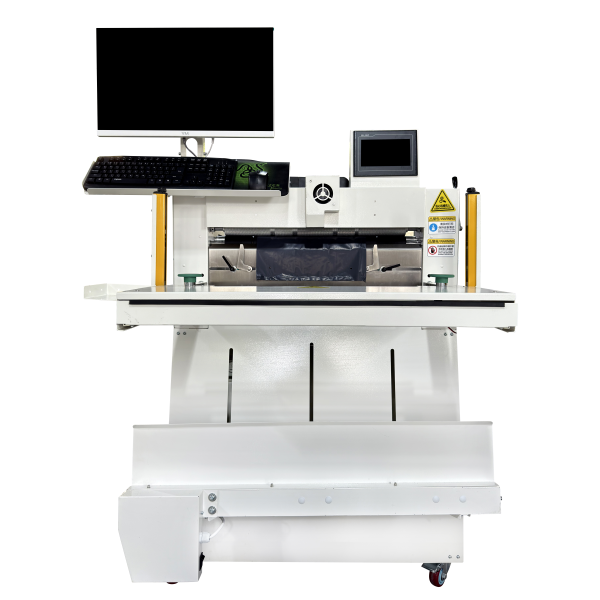
A tabletop auto bagger trades a few thousand dollars a month in labor for a fixed weekly equipment cost, and the trade pays back fast once volume clears the threshold. The YPX-BD60C runs up to 1,200 bags an hour; the compact YPX-XB40 runs up to 1,800 — both in the same throughput range as established Western brands such as Pregis, UBL, and TMI, at a meaningfully lower purchase price. Both are all-electric: no compressed air line, no facility modification, plug into a standard outlet.
| Rated throughput | 1,200–1,800 bags/hr (model-dependent), 5000+ orders/day |
|---|---|
| Headcount | 1 operator covers 80-120 orders/hr, 700–1,000 orders/day per shift |
| Footprint | ~14–15 sq ft, fits an existing pack station |
Real strengths
- Auto-measuring right-size bagging (on the YPX-K75A1) forms the bag to the product on the fly, so the station stops carrying a shelf of pre-cut bag-size SKUs
- Integrated print-and-apply labeling collapses two manual steps — print, then hand-apply — into one motion at the seal point
- 24-hour after-sales support, which matters more than list price once a machine is running three shifts through peak
Honest weaknesses — who it's not for
- Built overseas (Guangzhou), so freight typically runs 4–8 weeks longer than a domestic-brand machine — order ahead of peak, not during it
- Sized for single-site operations up to roughly 5,000+ orders/day; a multi-site enterprise WMS rollout needs a different conversation
- Newer company (founded 2021) — offset in practice by the 24-hour support commitment
Feature-by-Feature Comparison
Same six factors, side by side. For oversized or flat items, the YPX-WBD60A handles horizontal drop-style bagging; for the highest sustained volume, the YPX-K75A1 adds conveyor-fed right-size bagging at up to 20 cycles a minute.
| Factor | Tabletop Auto Bagger | Manual |
|---|---|---|
| Throughput | 600–1,200 bags/hr rated | 80–120 bags/hr per packer |
| Footprint | ~14–15 sq ft | 40–60 sq ft per station |
| Labor | 1 operator / 5,000+ orders/day | 1 packer / 700–1,000 orders/day |
| Error rate | 0.2%–0.5% | 1.5%–3% |
| Training time | 1–2 hrs to competency (job storage presets) | 1–3 shifts to reach full packing speed |
| Scalability | Add a shift or unit; fits up to ~5,000 orders/day, single site | Linear — every ~700–1,000 orders/day needs another hire |
When Manual Packaging Still Makes Sense
- Order volume under roughly 1,000/day. The labor cost of hand-packing is still lower than a machine payment.
- Highly irregular SKU mix. Oversized, fragile, or wildly variable dimensions that don't fit a standard bag range.
- Pre-launch or pilot brand. Committing capital before volume is proven adds risk without a clear return.
- No floor space — not even the roughly 14–15 sq ft a tabletop unit needs — at the current pack station.
Run the numbers against YPXPACK's tabletop lineup before ruling automation out entirely — some models fit tighter footprints than expected.
When to Switch to Tabletop Auto Bagger
- Volume has crossed the ~3,000–5,000 orders/day threshold and stayed there for more than a season.
- Pack-station turnover keeps resetting training time. Automation adoption in warehouses is accelerating industry-wide — PMMI projects one in four facilities will run some form of automation by 2027, up from just 14% in 2017, driven by exactly this labor math.
- Error and damage claims are rising. Every point of scrap above 1% is a stack of returns and reship labor.
- Peak season strain is forcing overtime or temp staffing that one operator on an auto bagger would absorb.
ROI and Payback: How Fast Tabletop Auto Bagger Pays for Itself
Three savings streams offset one fixed cost. The formula:
Worked example: a DTC brand shipping 1,000 orders/day, 5 days a week — about 20,000 orders a month — currently run by one packer plus overflow help.
Request a quote with your actual order volume and bag spec, and this same formula returns an exact payback figure instead of a range.
Frequently Asked Questions
What order volume justifies automating packaging?
Most single-site e-commerce operations see a positive return somewhere between 500 and 1,000 orders a day, depending on labor rates and current error or damage costs. Below that range, a part-time packer's fully loaded cost is usually cheaper than a machine payment.
What's the real cost difference between manual and automated packaging?
Manual packing needs almost no capital — under $3,000 per station — but costs $26–29/hr fully loaded per packer, scaling linearly with volume. A tabletop auto bagger costs $3,000–$15,000 upfront depending on configuration, then runs on one operator's time regardless of how much that operator's throughput increases.
What's a typical ROI timeframe?
6 to 12 months for most single-site e-commerce operations, depending on order volume, current error rate, and machine configuration. High-volume, high-error operations pay back faster; low-volume or low-error operations take longer.
Can small warehouses use a tabletop auto bagger?
Yes. Tabletop models run about 14–15 sq ft and plug into a standard outlet with no compressed air line or facility modification, so they fit into an existing pack station rather than requiring a dedicated equipment bay.
What ongoing maintenance does a tabletop auto bagger need?
Routine maintenance is light — bag roll changes, occasional seal-bar cleaning, and periodic sensor checks. YPXPACK backs its machines with 24-hour after-sales support for anything beyond that.
Next Step
Get a configuration and price quote
Send your order volume, bag size range, and label requirements — YPXPACK will size the right model and give a real payback number for your operation, not a published range.
Request a Quote →Labor cost figures reference U.S. Bureau of Labor Statistics wage data and PMMI's 2025 industry reporting, cited inline above. Equipment pricing, throughput, and footprint figures reflect typical configurations for this equipment class; request a quote for numbers specific to your order profile.

