
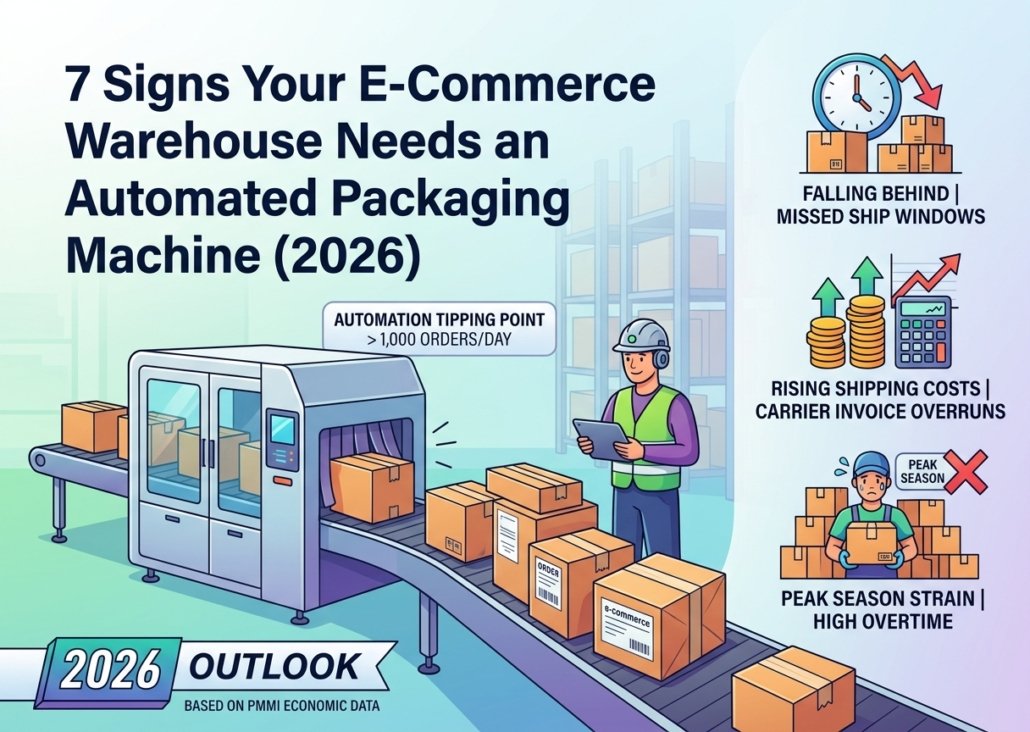
7 Signs Your E-Commerce Warehouse Needs an Automated Packaging Machine 2026
Operations Diagnostic · 2026
7 Signs Your E-Commerce Warehouse Needs an Automated Packaging Machine (2026)
If your pack team is falling behind, your bag and box inventory keeps multiplying, or peak season reliably breaks your operation — this diagnostic tells you exactly when to act, and how to size the investment correctly.
Missed ship windows, overtime every peak week, a storage shelf of pre-made bag and box sizes that keeps growing — manual packaging doesn't fail all at once. It erodes. By the time most operations directors consider automation, the daily cost of not acting is already outrunning what a machine would cost. At roughly 5,000 orders per day, that tipping point arrives fast. PMMI's 2025 economic outlook confirms packaging labor costs continue rising while headcount availability tightens — the math only gets harder to ignore.
Run through the five warning signs below. Click any that apply to your operation, then read the score at the bottom.
The 7 Signs
Detailed Breakdown
Your Pack Team Can't Keep Up With Order Volume
● CriticalThe symptom usually shows up on Friday afternoons: a cart of picked orders sitting untouched at pack stations while your team is already at capacity. By the time the shift ends, a portion of that day's orders will miss the carrier pickup — triggering same-day SLA failures, expedited shipping upgrades, and the downstream churn of customers who don't reorder after a late delivery.
Overtime covers the gap in the short term, but at a compounding cost. A 5-person pack team running two hours of overtime per day at $18/hour adds $1,800 per week in labor alone — before factoring in SLA penalty credits or lost repeat revenue.
The threshold to watch: when your team regularly maxes out headcount at or below 5,000 orders per day without overtime, adding a single automated bagger — such as the YPXPACK YPX-BD60C Drop-Style Tabletop Auto Bagger — typically closes that gap at a predictable throughput rate, no shift extensions required.
You're Stocking a Different Bag Size for Every Product Length
● High PriorityManual poly bagging runs on pre-made bags, and pre-made bags only come in fixed sizes. To cover a product line with any real variation in dimensions, that means stocking a small bag, a medium, a large, an extra-large — each one a separate purchase order, a separate storage bin, and a separate inventory line your team has to track and reorder. Every time the product catalog grows or a new SKU falls between two existing sizes, the bag library grows with it.
That bag-size sprawl carries the same hidden cost pattern as carton stockpiling: capital tied up in inventory that sits unused between order spikes, storage space consumed by boxes of pre-made bags in sizes you only need occasionally, and a packer who has to correctly match product to bag size under time pressure — with the wrong match producing either a too-tight bag that won't seal cleanly or a too-loose one that ships an order looking unfinished.
An auto-measuring right-size bagger eliminates the bag-size library entirely. The YPXPACK YPX-K75A1 forms each bag from a single roll of film, using beginning- and end-of-product sensors to measure the item in real time and size the bag to it — no pre-cut sizes to stock, no SKU-matching decision at the pack station, no separate purchase order every time a new product length enters your catalog. One film roll covers products up to 25.59″ wide and 29.53″ long, hot-knife sealed and labeled in the same pass at up to 20 bags per minute.
Packaging Errors and Damage Claims Are Climbing
● CriticalInconsistent seal pressure, wrong bag size chosen under time pressure, products arriving damaged because a too-large box let contents shift in transit — these are not random events. They are predictable outputs of a high-volume manual process where fatigue and speed trade off against accuracy as the shift progresses.
The financial exposure compounds fast. Each damage or error claim requires: the replacement product cost, return shipping, customer service handling time, and — most durably — the erosion of repeat purchase likelihood. A customer who receives a damaged order has a roughly 50% lower probability of reordering, regardless of how the claim is resolved.
Automated bagging applies the same seal pressure and selects the correct bag format on every cycle. When the machine sets the parameters, human fatigue stops being a quality variable. The threshold to act: error or damage complaints exceeding 0.5% of orders, or when claims exceed 1% of monthly revenue. See YPXPACK's FAQ on machine seal consistency for specifics on seal quality standards.
Labor Turnover at Your Pack Stations Is Constant
● High PriorityRepetitive manual packing — lifting, folding, sealing, labeling, repeat — is physically demanding and cognitively monotonous. The labor market reflects this. Pack-station roles in e-commerce fulfillment average some of the highest turnover rates in the warehouse, with many operations cycling through 40–50% of their pack headcount annually.
The hidden cost of that churn is almost always underestimated. Every departure triggers a recruiting cost (job postings, agency fees, HR time), a ramp period where the new hire operates at 60–70% of an experienced packer's speed, and a quality dip during that window.
The YPX-BD60C Tabletop Auto Bagger reduces the most physically demanding repetitive motions at the pack station — an operator loads product and the machine handles the rest. YPXPACK's 24-hour after-sales support means machine onboarding typically takes hours, not the weeks a new manual hire needs to reach full speed.
Your Carton Sealing Line Stops Every Time the Box Size Changes
● Medium PriorityMost carton sealers are built around a fixed size range — set up once for one type of box, and anything outside that range gets routed to a different process. That works fine for a single-product operation. It breaks down fast for a multi-SKU catalog, where a small electronics accessory, a mid-size apparel order, and a bulky home-goods item all need to ship from the same pack station, in the same shift, without three separate sealing setups.
The result is a packaging process that's effectively several processes stitched together: one machine or method for small parcels, manual hand-sealing for anything outside the standard range, and a stockpile of pre-cut box sizes to bridge the gap. None of this shows up as a single line item on a P&L — it shows up as fragmented throughput, inconsistent seal quality across SKU types, and a pack station that can't flex as your product mix grows.
An auto-adjusting carton sealer solves this by treating size range as a spec, not a constraint. The YPXPACK YPX-ZFD50B1 reads each carton's real dimensions and seals it accordingly — covering small e-commerce parcels through large industrial cartons on one all-electric machine, with print-and-apply labeling built into the same pass. Whether your next order is a phone case or a kitchen appliance, it's the same line, same operator, same machine.
Peak Season Breaks Your Operation Every Year
● CriticalThe standard model frames peak season as a Q4 problem. For operations selling across Amazon, eBay, TikTok Shop, AliExpress, Temu, Shopee, Mercado Libre, Jumia, and Takealot, that framing is outdated by several years. Amazon Prime Day lands in July. Shopee runs monthly peak events — 9.9, 10.10, 11.11, 12.12 — each capable of tripling daily order volumes across a 48 to 72-hour window. AliExpress and Temu's 11.11 Singles’ Day is the single largest global order event in e-commerce, routinely surpassing Black Friday and Cyber Monday combined. TikTok Shop's flash sale format can spike a single SKU from 50 orders per day to 5,000 within hours of a viral video — with no advance notice to your packaging line. Mercado Libre's Hot Sale in May and Buen Fin in November define the two dominant e-commerce peaks across Latin America. Jumia's Black Friday is the highest-volume online retail event across Sub-Saharan Africa. Takealot's Black Friday drives the largest single-day order volume in South African e-commerce. Multi-platform operations now face 10 to 15 distinct high-volume events distributed across the full calendar year.
The underlying constraint is identical regardless of which platform triggers the spike: the manual packaging throughput ceiling stays fixed while order volume multiplies. What changes for multi-platform sellers is frequency. When you are running 10 or more distinct peak windows per year, temp labor is no longer a seasonal workaround — it becomes a permanent and recurring operational overhead. Every hiring cycle brings the same sequence: job posting, screening, onboarding, a two to three week quality ramp, and then departure. At Shopee's 9.9 event, you need full throughput on September 9th specifically — not September 14th when the new hire reaches productive speed. At TikTok Shop, you may have 24 hours of notice or none at all.
One YPXPACK auto bagger running a standard shift delivers the throughput of three to four manual packers from the first hour of every event — whether that is Amazon Prime Day in July, AliExpress 11.11 in November, Shopee's 9.9 in September, or a TikTok Shop flash sale that spiked at 2pm on a Tuesday with no prior warning. No recruiting cycle, no ramp period, no post-event departure. The threshold to act is no longer only Q4 labor cost exceeding twice your monthly standard. If your operation sells on three or more platforms with independent promotional calendars, your peaks have become a year-round structural constraint — and the manual packaging ceiling is costing you on every one of them. Talk to YPXPACK about capacity planning before your next major platform event window opens.
Your Customers Are Complaining About the Unboxing Experience
● High PriorityPackaging complaints in reviews follow a predictable pattern: "arrived in a box three times too big," "everything shifted around," "the bag was barely sealed." These aren't aesthetic grievances — they signal that the product's perceived quality is being undermined before the customer even uses it. At any meaningful order volume, manual packing introduces enough variability in seal quality, box selection, and void fill that the unboxing experience becomes inconsistent by design.
Consumer packaging research consistently shows that roughly one in three customers shares a negative packaging experience with their network — in reviews, on social media, or in direct conversation. At 5,000 orders per day, even a 2% complaint rate means 100 customers per day becoming active detractors.
Automated packaging produces the same seal quality and package dimensions on every order. YPXPACK's print-and-apply capability integrates branded label printing into the bagging cycle — a clean, right-sized bag with a professional label applied in one pass is the baseline output of machines like the YPX-K75A1, without adding a separate labeling station.
Machine Selection
What to Look for in Your First Automated Packaging Machine
Match your machine type to your primary pain point first, not your budget. Throughput bottleneck → look at auto bagger or auto sealer speed specs (units/minute at your average order profile). Bag or box size inventory sprawl → start with an auto-measuring, right-size system that eliminates pre-cut size stocking. Labeling inefficiency adding a separate station → print-and-apply integration is the spec to prioritize.
Floor space and power requirements eliminate more options than price does at the compact end of the market. Most e-commerce pack stations need a tabletop unit in the 10–15 square foot footprint — not a full conveyor line that requires dedicated floor planning and electrical infrastructure. Measure your pack station before shortlisting machines.
Integration matters more than the spec sheet suggests. Confirm whether the machine accepts label data from your WMS or OMS via API, Ethernet, or a basic data feed — this determines whether it slots into your existing workflow or requires a parallel manual process. Ask for a specific data integration spec sheet, not a general "integrates with major platforms" claim.
After all of that: support terms and warranty coverage determine your true cost of ownership more than the sticker price. A machine that goes down during peak season without a 24-hour support response is worth considerably less than its purchase price at that moment.
Comparable throughput specs to Western brands at a significantly lower price point — built specifically for e-commerce pack station form factors.
Label printing and application integrated into the bagging or sealing cycle — eliminating a separate labeling station and the labor that feeds it.
Tabletop and desktop units designed for existing pack stations — no new conveyor line, no major floor reconfiguration.
Round-the-clock technical support response and a 1-year electrical components warranty — support terms matched to e-commerce operational hours.
Frequently Asked Questions
Frequently Asked Questions
Most operations see positive ROI starting at around 5,000 orders per day, when labor, bag/box inventory savings, and error-cost avoidance are combined in the payback calculation. Below that threshold, semi-automation — tape dispensers, manual label applicators, basic case sealers — often delivers better return per dollar than a fully automated system.
The threshold isn't universal. If your labor cost per order is high (e.g., high-cost metro labor market), the math can justify automation at lower volumes. If your product catalog spans a wide size range, the bag- or box-inventory savings alone can drive payback sooner. See YPXPACK's full FAQ for volume-to-machine matching guidance.
Semi-automatic machines run continuously without requiring an operator to trigger each cycle — but switching between carton formats or sizes requires manual intervention, such as adjusting guide rails or changing the format set. Fully automatic machines handle format changeovers automatically via servo-driven adjustments, requiring an operator only for loading bulk material and clearing exceptions.
Most e-commerce operations recoup machine investment in 6–12 months when labor savings, packaging inventory savings, and error-cost avoidance are calculated together. The range is wide because each operation's cost structure is different — a high-overtime environment in a high-wage market pays back faster than a low-volume operation with low labor costs.
Formula: (monthly labor savings + monthly packaging inventory savings + monthly error cost reduction) ÷ machine cost = payback in months. Request a YPXPACK quote with your order volume and current labor costs to get a machine-specific ROI estimate.
Yes — tabletop auto baggers and compact carton sealers are built specifically for space-constrained pack stations. A machine like the YPXPACK YPX-XB40 Tabletop Auto Bagger fits comfortably on an existing pack bench in under 10 square feet of footprint, requiring only a standard power outlet.
Full conveyor-integrated systems do require 500+ square feet of dedicated line space, three-phase power, and facility planning. These are enterprise-scale deployments for operations above 5,000+ orders per day. Small and mid-size warehouses don't need that level of infrastructure to benefit from automation — the tabletop tier solves the same core problem at a fraction of the cost and footprint.
