
What Should You Ask Before Buying an Automated Bagging Machine?

Questions to Ask Before Buying an Automated Bagging Machine | YPXPACK

Procurement Guide · E-Commerce Packaging Automation

What Should You Ask Before Buying an Automated Bagging Machine? 7 Questions That Separate Good Investments From Costly Mistakes

A wrong automated bagging machine purchase locks your operation into 3–5 years of the wrong throughput, the wrong film, and the wrong support model — at $loss per hour of unplanned downtime, that's a risk measured in six figures. This checklist gives procurement teams a concrete vetting framework across four decision areas before a purchase order is signed.
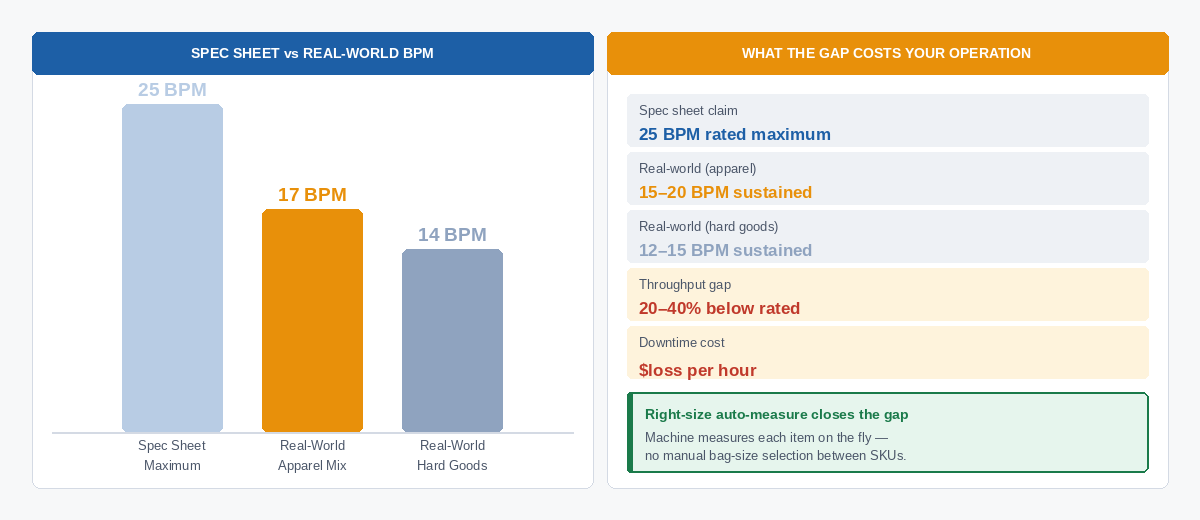
Spec sheet vs real-world throughput comparison on a mixed-SKU e-commerce fulfillment line

FIG. 1 — Spec sheet vs. real-world throughput: rated 25 BPM vs. sustained 15–20 BPM on mixed-SKU e-commerce apparel line

Downtime cost
$loss/hr
Throughput gap
20–40%
Consumable lock-in premium
25–40%
Changeover benchmark
< 2 min

Before You Compare Spec Sheets: Four Decision Areas That Matter

Every automated bagging machine datasheet looks similar at a glance — throughput in bags per minute, seal width, film gauge range, electrical power consumption/compressed air requirement. The differences that will determine whether your line runs profitably for the next five years don't appear on any spec sheet. They surface in four areas: machine performance for your actual SKU mix, system integration and line automation, total cost of ownership over the machine's lifespan, and after-sales support and supplier reliability. The seven questions below map to each. Ask all of them before you sign anything.

For a broader overview of packaging machine categories and selection frameworks, PMMI's packaging machinery resource center is a useful industry reference. For YPXPACK's specific product lineup, see the product catalog pages.

01Decision Area One — Machine Performance

Machine Performance for Your Actual Products

Lab-conditions throughput numbers are calibrated for a single, uniform SKU run under ideal film tension and ambient temperature — not a fulfillment center running 200 different product sizes across three shifts.

1What Is the Real-World Throughput With My Specific SKUs — Not the Spec Sheet Maximum?

⚡ At StakeThe gap between rated BPM and real-world BPM typically runs 20–40% when handling mixed SKU sizes or irregularly shaped products. At $loss/hr downtime cost, a machine that can't sustain target throughput forces overtime or missed shipment windows.
Automated bagging machine throughput test comparing spec sheet BPM to real-world sustained BPM on mixed-SKU e-commerce fulfillment line
FIG. 1 — Spec sheet vs. real-world throughput comparison on a mixed-SKU e-commerce fulfillment line.
Ask the Supplier Can you provide a timed throughput demonstration with a sample of my actual SKUs — including your smallest, largest, and most irregular items? What's your documented BPM range by SKU category, not just the peak figure?
Strong Answer Supplier offers a live or video-recorded test run with customer-provided products, or quotes a documented realistic BPM range by SKU type (e.g., "apparel polybag: 17–20 BPM sustained; small hard goods: 14–16 BPM") rather than citing only the lab maximum.
Red Flag Supplier quotes only the rated peak and declines to demonstrate with your product mix. Any answer containing "up to X BPM" with no qualification for SKU size variance should be probed further.
📊 Industry benchmark: A right-size auto bagger running mixed e-commerce apparel typically sustains 15–20 BPM against a rated maximum of 25 BPM. Plan your line capacity around the realistic figure, not the spec sheet.
YPXPACK The YPX-K75A1 auto-measures each item's length at the infeed and forms a right-sized bag on the fly — eliminating the manual bag-size selection step that causes slowdowns and operator errors on mixed-SKU lines. The throughput gap between spec and reality narrows because there's no changeover between bag sizes.

2Am I Locked Into Buying Consumables Exclusively From the Supplier?
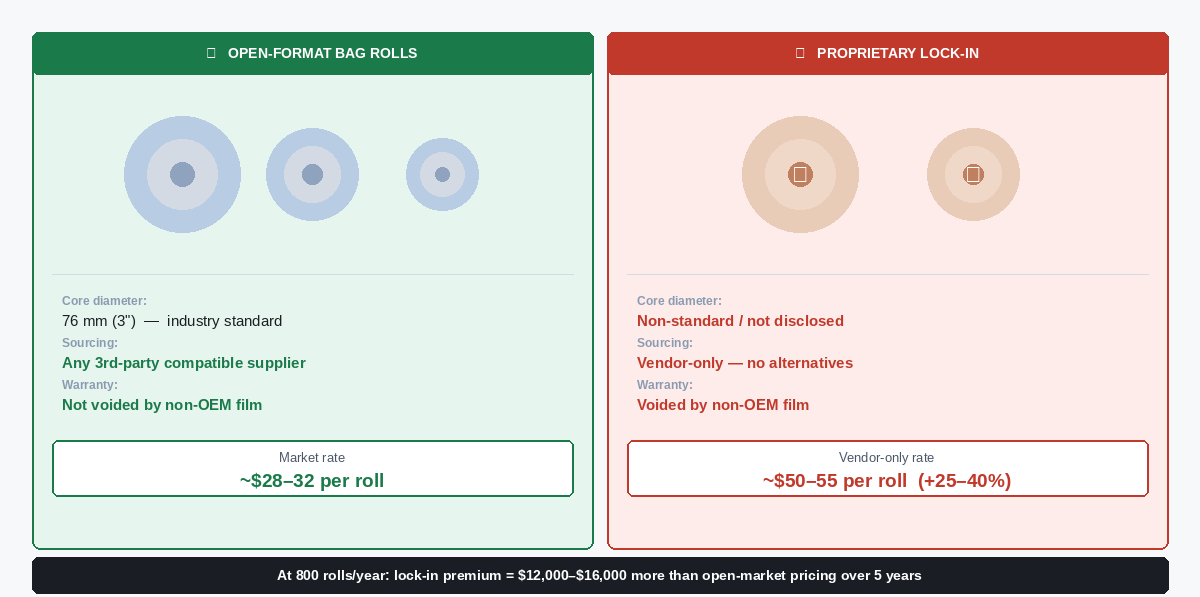
⚡ At StakeProprietary bag-roll lock-in removes your ability to source competitively. For example, a roll priced at $50 that costs $30 on the open market, across 800 rolls/year, adds $16,000 in avoidable annual cost — compounded over a 5-year machine lifespan.
Open-format vs proprietary bag roll comparison showing consumable lock-in premium of 25-40 percent above market rate
FIG. 2 — Open-format vs. proprietary bag roll compatibility — the difference compounds significantly at high volumes.
Ask the Supplier What are the core diameter and perforation pitch specifications for the bag rolls this machine accepts? Can I purchase compatible rolls from third-party suppliers, and will doing so void my warranty?
Strong Answer Machine accepts standard pre-opened bag rolls with industry-common core diameters (typically 76mm or 3") and standard perforation spacing. Supplier provides written confirmation that third-party compatible rolls don't void the warranty.
Red Flag "Technically possible but not recommended" or any language tying warranty coverage to use of the supplier's own consumables. Also: supplier can't provide core diameter specs in writing.
💰 Cost reality: Proprietary consumable lock-in premiums run 25–40% above open-market bag pricing. For a high-volume e-commerce operation consuming 800+ rolls/year, that's $12,000–$16,000 in avoidable annual spend. For current poly mailer film standards, see FPA (Flexible Packaging Association) resources.

3How Does the Machine Handle Eco-Friendly and Recycled-Content Films?
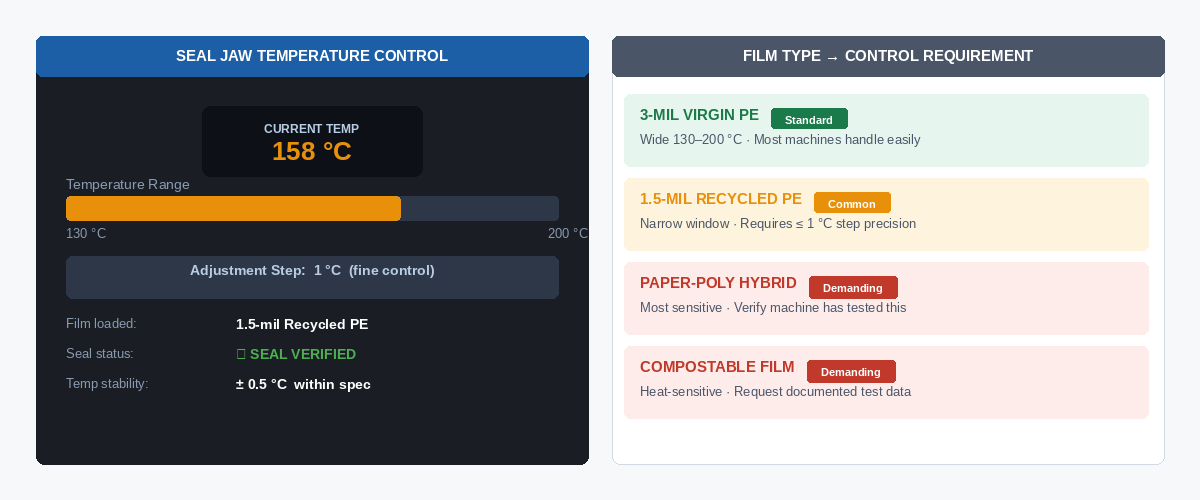
⚡ At StakeMost major retailers now mandate recycled-content or compostable poly mailers from their suppliers. A machine that can only run 3-mil virgin PE has an 18–24 month window before it becomes a compliance liability — making it functionally obsolete before the lifespan payback is complete.
Seal jaw temperature control requirements by film type - recycled content films demand tighter precision than standard 3-mil virgin PE
FIG. 3 — Seal jaw temperature control requirements by film type — recycled-content films demand tighter control than standard 3-mil virgin PE.
Ask the Supplier Has this machine been tested with 1.5-mil recycled PE, paper-poly hybrid, and compostable film? What is your seal jaw temperature range, and how fine is the adjustment increment? Can you provide a film compatibility list with documented test results?
Strong Answer Sealing jaws with fine-increment temperature control (ideally 1°C steps) across a range of at least 130–200°C, with documented test results for at least two eco-film formats. Supplier can name specific film suppliers they've tested with.
Red Flag Machine spec sheet only references "standard poly film" with no gauge or material type specified. Supplier has not tested recycled-content or paper-poly hybrid films. Temperature adjustment in coarse increments (10°C steps) only.
🌱 Benchmark: Standard seal temperature range is 130–200°C. Recycled PE films typically need tighter control at the lower end of that range — machines with only coarse adjustment burn recycled film consistently. For current sustainable packaging standards, How2Recycle program guidelines are the relevant retailer reference.
02Decision Area Two — System Integration

System Integration and Line Automation

An auto bagger that can't communicate with your WMS, print labels inline, or connect to upstream conveyors is an expensive standalone tool — it replaces one manual step while leaving the bottlenecks around it intact.

4How Does This Machine Integrate With My WMS and Inline Label Printing?
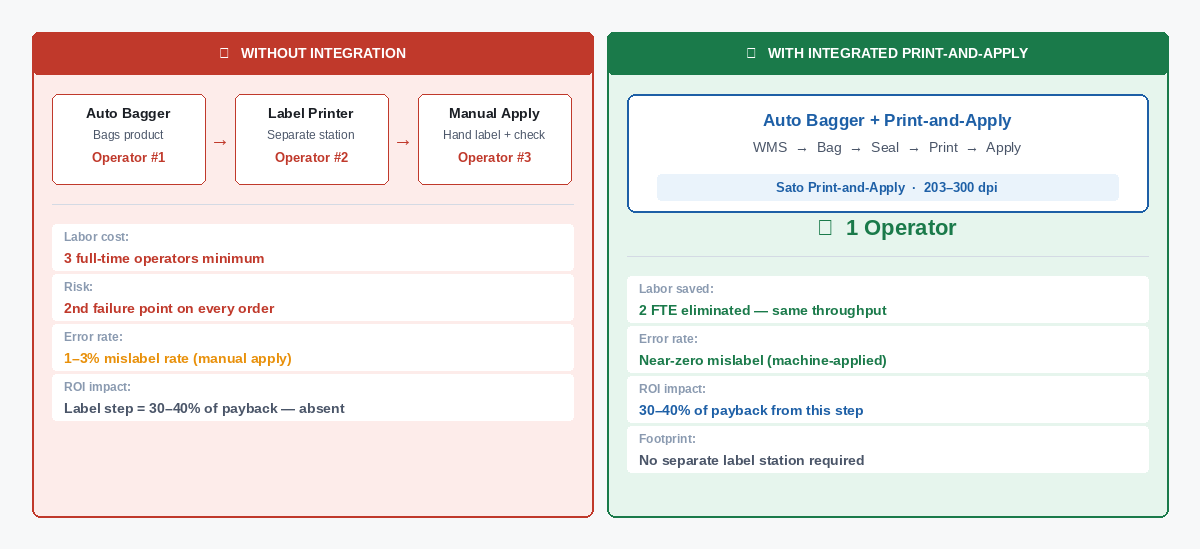
⚡ At StakeWithout WMS connectivity and inline print-and-apply, operators still handle a separate label-print-and-stick step after bagging — eliminating none of the labor cost that justified the machine investment. A separate label station also introduces a second failure point on the line.
Operator count comparison: standalone bagger requires 3 operators across 3 stations vs integrated print-and-apply system requiring 1 operator
FIG. 4 — Operator count comparison: standalone bagger vs. integrated print-and-apply system. One pass eliminates the most common manual touch point.
Ask the Supplier What WMS connectivity protocols does the machine support — TCP/IP, REST API, serial? Is a label printer integrated at the seal station, or does it require a separate downstream unit? What print resolution is supported, and can it handle both ribbon and direct thermal?
Strong Answer Open API or TCP/IP connectivity to WMS; integrated thermal print-and-apply applicator that fires at point of seal, 203–300 dpi resolution, with both ribbon and direct thermal options explained. Supplier can name WMS platforms they've integrated with.
Red Flag Integration requires custom middleware that only the vendor can build and maintain. Label printer is a separate, self-contained unit with no physical coupling to the bagger. Supplier can't name a WMS they've successfully integrated with.
🏆 Best-in-class benchmark: Leading e-commerce auto baggers combine bag-form, seal, and label application in one pass — eliminating one full operator station. That labor saving alone typically accounts for 30–40% of the ROI justification.
YPXPACK Both the YPX-K75A1 and YPX-BD60C include an integrated Sato print-and-apply labeler. The shipping label is printed and applied at the seal station — no separate label station, no second operator, no mislabeled packages from manual application.

5What Is the Realistic Changeover Time Between Bag Sizes?
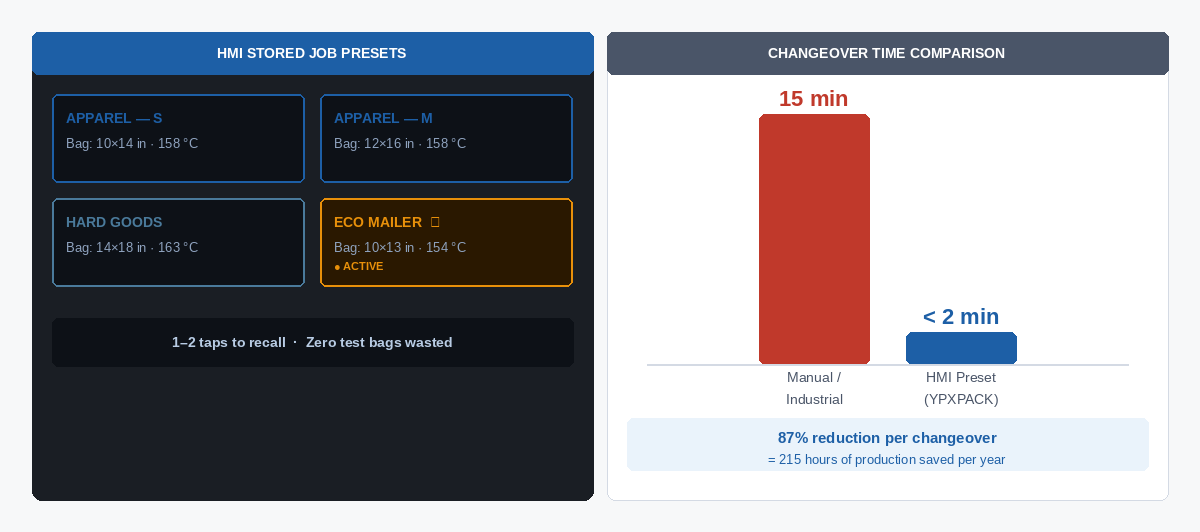
⚡ At StakeIn a high-mix e-commerce operation, bag-size changeovers happen 3–6 times per shift. A 15-minute changeover vs. a 2-minute changeover at 4 changeovers/day costs 52 minutes of lost production — every single day. Over a 250-day operating year, that's over 215 hours of lost throughput.
Auto bagger HMI touchscreen with stored job presets enabling fast changeover under 2 minutes vs 15-minute manual changeover on industrial machines
FIG. 5 — HMI stored job presets reduce bag-size changeover from 15 minutes to under 2 minutes — a compounding daily efficiency gain on mixed-SKU lines.
Ask the Supplier Can you demonstrate a live changeover from one bag size to another? Is it tool-less? Does the machine store HMI presets so operators don't re-enter settings manually? How many test/waste bags are needed to confirm seal quality after changeover?
Strong Answer Tool-less changeover, HMI-stored job presets that recall all settings (temperature, bag length, speed) in 1–2 taps, zero test bags wasted after recall, and a demonstrated changeover time under 3 minutes. Supplier performs this live on request.
Red Flag Changeover requires mechanical adjustment with tools, manual re-entry of seal temperature and bag length settings, or a run of 5–10 test bags to verify seal quality. Supplier is unable or unwilling to demonstrate changeover.
⏱️ Benchmark: Leading e-commerce auto baggers complete bag-size changeovers in under 2 minutes with zero test bags wasted. Industrial-grade and older machines average 15–20 minutes. For packaging line changeover methodology, PMMI's industry tools include SMED frameworks applicable to bagging lines.
YPXPACK The YPX series touchscreen stores all job parameters per SKU category. Operators switch between bag sizes with 1–2 taps — no tool, no manual temperature re-entry, no test waste. New operators can run changeovers correctly after minimal training.
03Decision Area Three — Total Cost of Ownership

Total Cost of Ownership Over the Machine's Lifespan

The purchase price is typically 25–35% of what you'll actually spend over a 5–7 year machine lifespan. Maintenance contracts, wear parts, consumable margins, and downtime cost account for the rest — and most of that is invisible at the point of sale.

Hidden costs in automated bagging machine ownership — 5 cost categories
Cost CategoryVisible Cost (what you see in the quote)Hidden Cost (what hits your P&L later)
EquipmentMachine purchase priceFreight, rigging, compressed air line installation ($2,000–$5,000 if not already in place)
ConsumablesQuoted bag-roll unit priceProprietary lock-in premium (25–40% above market); wasted film from jams, test runs, and misfeeds
Maintenance"1-year warranty included"Wear parts every 2–12 months; OEM technician travel fees; lost production during unplanned downtime ($loss/hr)
LaborOperator hourly wageChangeover time (15 min × 4/day = 1 hr/day of non-productive labor); jam clearing; training churn on complex UIs
OpportunityOrders delayed or cancelled during peak-season downtime; overtime to compensate; customer churn from late shipments

6What Are the Most Common Wear Parts, and What Do They Cost Annually?
⚡ At StakeA machine priced $5,000 lower upfront but requiring $3,000/year in proprietary wear parts costs $10,000 more over 5 years — before factoring in the labor to source and install them. A supplier who won't provide a wear-parts list pre-purchase is hiding this math from you.
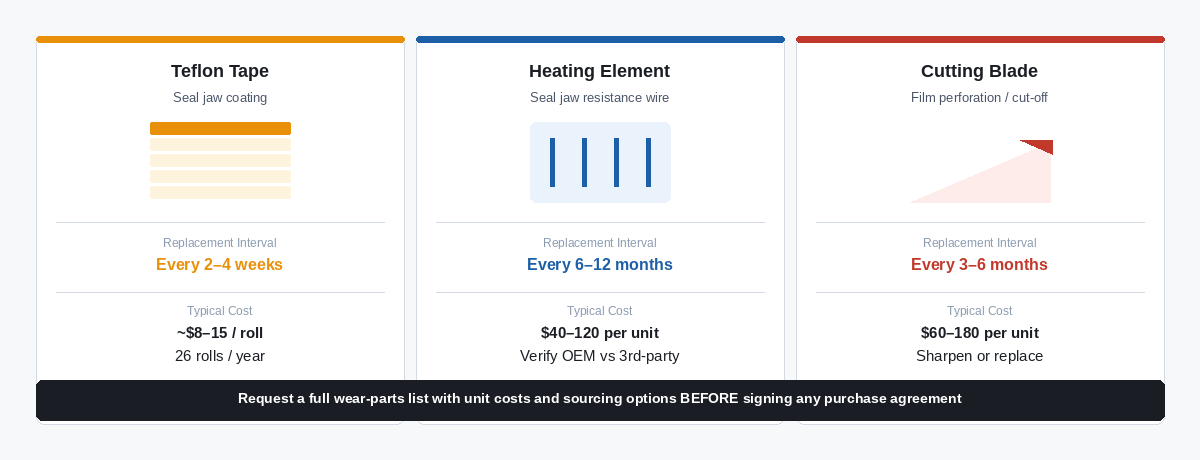
Automated bagging machine wear parts diagram showing Teflon tape, heating element, and cutting blade with their replacement intervals and annual costs
FIG. 6 — The three highest-frequency wear parts on poly bagging machines — replacement intervals and indicative costs at typical e-commerce volumes.
Ask the Supplier Can you provide a complete wear-parts list before we sign, including: part name, unit cost, expected replacement interval at our projected volume (state your volume), and whether each part can be sourced from third-party suppliers without voiding the warranty?
Strong Answer Supplier provides a pre-purchase wear-parts list with itemized costs. Machine uses standard off-the-shelf components — common PLC brands (Siemens, Omron, Allen-Bradley), standard sensors, non-proprietary heating elements — with documented third-party sourcing confirmed in writing.
Red Flag "We'll cover that in the service contract" or any deflection from providing a specific parts list pre-purchase. Proprietary heating elements and sensors with no third-party equivalents. PLC brand is obscure or unmarked — often means replacement requires OEM involvement.
🔧 Common wear intervals for poly bagging machines: Teflon tape on seal jaws (every 2–4 weeks under heavy use), heating elements (6–12 months), cutting blades (3–6 months, sharpen or replace). For packaging equipment TCO methodology, PMMI's lifecycle cost tools provide a structured framework.
04Decision Area Four — After-Sales Support

After-Sales Support and Supplier Reliability

When your line goes down at 11 PM the night before a peak shipping deadline, "we'll respond within 48 business hours" is not a support model — it's a liability.

7What Is Your Guaranteed Response Time, and Where Are Spare Parts Stocked?
⚡ At StakeA $50 heating element sourced from an overseas-only depot can halt production for 1–2 weeks waiting for international shipping — costing 8 hrs/day * 7days * $loss/hr in downtime at $loss/hr across a 7-day line stoppage. The part cost is irrelevant. The downtime cost isn't.
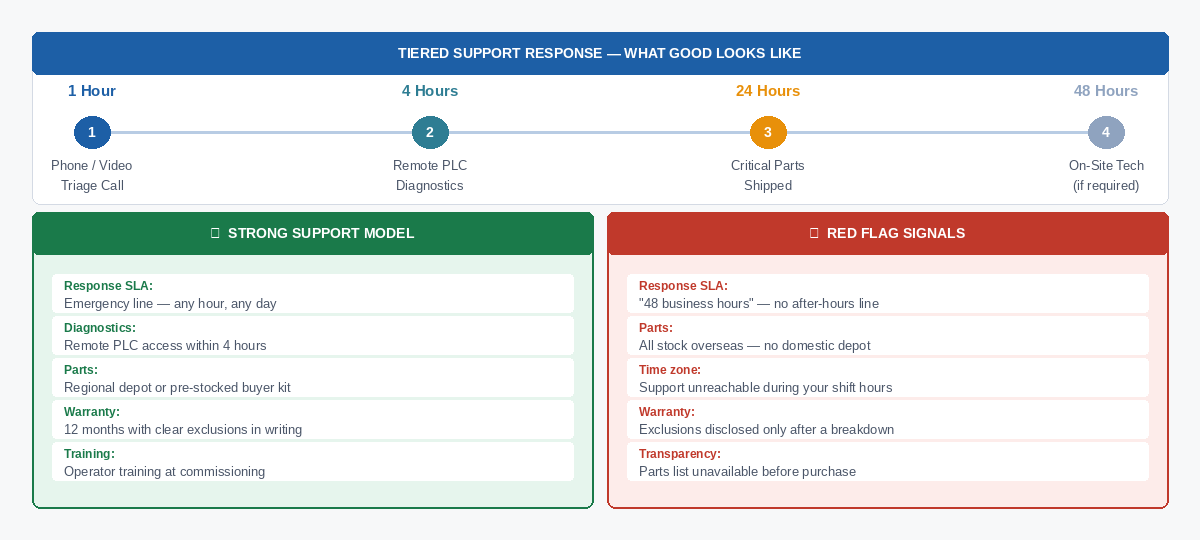
Support tier timeline showing strong model with 1-hour phone triage, 4-hour remote PLC diagnostics, 24-hour parts shipped, 48-hour on-site tech vs red flag model with 48 business hours SLA and overseas-only parts
FIG. 7 — Tiered support response benchmarks — what a strong after-sales model looks like vs. common red flags at the contract stage.
Ask the Supplier What is your guaranteed response time for emergency line-down support, including outside business hours? Where are spare parts physically stocked — can I get critical parts domestically within 24–48 hours? What is explicitly excluded from the standard warranty?
Strong Answer Tiered support: phone/video triage within 1 hour; remote PLC diagnostics within 4 hours; critical spare parts available with next-day or same-week domestic shipping; on-site within 24–48 hours if required. Warranty terms provided in writing with a specific list of exclusions.
Red Flag All parts ship from overseas with no regional depot or domestic inventory option. Support is only available during the supplier's business hours, with no emergency line. Warranty exclusions are vague or only disclosed during a breakdown.
📋 Warranty standard: Industry standard covers parts for 12 months — but always get the exclusions list before signing. Wear items (Teflon tape, heating elements, bag clamps, cutting blades) are typically excluded, even on new machines. Confirming this upfront prevents billing disputes later.
YPXPACK YPXPACK provides 24-hour after-sales support and supplies a recommended spare-parts kit with every system — buyers who stock it on-site eliminate the shipping lead-time risk entirely. Parts ship from Guangzhou; with a pre-stocked kit, most maintenance needs are handled from local inventory. Contact the YPXPACK team to get the spare-parts kit specification for your model.

Frequently Asked Questions

How far below the spec-sheet BPM should I expect real-world throughput to be?

For single-SKU runs of uniform, flat items (standard poly mailers for apparel), the gap between rated and real-world BPM is typically 10–20%. For mixed-SKU operations with variable product dimensions, irregular shapes, or frequent bag-size changes, expect a 20–40% gap.

The primary variables are: product dimensional variance (wider range = slower), film jam rate (higher with thinner or recycled films until tension is tuned), and changeover frequency. Always request a throughput demonstration with a sample of your actual SKUs — not the supplier's demo product — before committing.

Does an automatic bagging machine require compressed air, and what does my facility need?

It depends on the machine. Most conventional auto baggers are pneumatic — they use compressed air for bag opening, clamping, and label application mechanisms. Typical requirements are 80–100 PSI at 4–6 CFM. If your facility doesn't already have a compressed air line at the installation point, adding one typically costs $2,000–$5,000. That infrastructure cost is invisible in the machine quote but real on installation day.

Fully electric machines eliminate this entirely. YPXPACK's tabletop auto baggers — the YPX-XB40, YPX-BD60C, and YPX-WBD60A — are fully electric and require only a standard power outlet. No compressor, no air lines, no installation contractor. The one exception in the YPXPACK lineup is the YPX-K75A1 right-size bagger, which is pneumatic and does require compressed air.

Beyond the infrastructure saving, fully electric machines carry several operational advantages worth factoring into your TCO: no compressor energy draw running continuously in the background, no moisture contamination risk from condensation in air lines, quieter operation on the floor, and one fewer mechanical system to maintain. For facilities already running compressed air at the right spec, the difference is minor. For facilities that would need to add infrastructure, a fully electric machine can shift the acquisition economics significantly.

How do I know if I'm locked into proprietary bag consumables before I sign?

Three things to check before signing: (1) Ask for the bag roll core diameter and perforation pitch in writing — if the supplier refuses or can't provide them, that's a lock-in signal. (2) Ask directly: "Does using third-party compatible bag rolls void the warranty?" Get the answer in writing, not verbally. (3) Read the warranty document for phrases like "supplied consumables only" or "approved materials" — these are contractual lock-in clauses.

Open-format machines specify standard industry dimensions. If the supplier says the specs are proprietary, you're locked in. Budget a 25–40% consumable cost premium and factor that into your 5-year TCO calculation before comparing machine prices.

What is a realistic changeover time benchmark for high-mix e-commerce operations?

For e-commerce auto baggers with HMI-stored presets and tool-less changeover: under 2 minutes with zero test bags is achievable and should be your minimum requirement. Some models with particularly optimized film-path design complete changeovers in 60–90 seconds.

Industrial-grade or general-purpose baggers not designed for high-mix e-commerce average 15–20 minutes per changeover with 5–10 test bags needed to verify seal quality. At 4 changeovers/shift on a 250-day operating year, that's the difference between 33 hours and 215 hours of lost production annually. Ask for a live demonstration timed in front of you.

Should I buy or lease an automatic bagging machine?

Buy if: your volume is consistent enough to project a 3–4 year payback, you have capital available, and you're confident in the machine selection after properly vetting the supplier. Outright ownership eliminates ongoing lease payments and gives you full flexibility on maintenance sourcing.

Lease if: your order volume is seasonal or unpredictable, you want to preserve cash for other capital priorities, or you're uncertain about the right machine configuration and want flexibility to upgrade in 2–3 years. Lease payments typically run 15–25% of the machine's value annually — confirm whether the agreement includes or excludes maintenance. For e-commerce operations with consistent daily volume above 500 orders, purchase generally produces better 5-year economics than leasing. Check with YPXPACK's team for a volume-specific payback calculation.

Next Step

Ready to Put These Questions to a Supplier?

You now have a concrete vetting framework across four decision areas: machine performance, system integration, total cost of ownership, and after-sales support. YPXPACK's team addresses all seven of these questions in the first consultation — and provides a recommended spare-parts kit specification with every system, so parts lead times don't become a production risk.

Request a Consultation with YPXPACK →

Throughput benchmarks reference typical e-commerce poly bagging machine performance across apparel and soft goods SKU categories. Downtime cost figures reference industry-standard packaging line loss estimates. Equipment pricing ranges reflect typical configurations; request a quote for numbers specific to your product mix and label requirements.